By Meera Ajesh, Chief Operating Officer, ThinkFilter, Aweer warehouse, Dubai. Last updated 27 August 2026.
Fujairah is the world's second-largest bunkering port after Singapore, with roughly 8 million tonnes of marine fuel sold to visiting tonnage in 2024 (Fujairah Oil Industry Zone data, 2024). Khor Fakkan and Jebel Ali between them handle a container throughput that keeps ISO 8217 compliance, Racor spare-parts availability and fuel-water separation planning permanently on the chief engineer's whiteboard.
Stock we hold for UAE ports sits on marine filtration solutions. This guide is the ISO 8217 walk-through and the Racor / Parker families. That page is the inventory.
This guide is the working reference for the marine filtration side of that operation, the ISO 8217 fuel specification, the primary/secondary filter architecture that keeps vessels on schedule, and the platform-specific detail on Racor and Parker product families that most engineering superintendents ask about.
Table of Contents
- Why marine filtration is a Fujairah-specific problem
- ISO 8217 fuel specification: what actually matters at the manifold
- Marine fuel filtration architecture: primary and secondary
- Racor product families for UAE waters
- Parker fuel and hydraulic filtration on marine platforms
- Air and crankcase filtration on marine diesels
- Operating condition specifics: Dubai, Fujairah, Khor Fakkan
- FAQ
Why marine filtration is a Fujairah-specific problem
The Gulf's bunkering profile is the single biggest operational reason marine filtration in the UAE needs its own reference rather than a copy of a European standard. Fujairah's location, outside the Strait of Hormuz, on the Arabian Sea coast, makes it the natural bunker port for vessels transiting between the Suez Canal, Cape route and Far East, and the volume is enormous. Roughly 4,500 vessels take bunkers at Fujairah anchorage each year (Port of Fujairah statistics, 2024). Khor Fakkan and Dubai (Port Rashid, Jebel Ali) add coastal and container-ship demand on top of that.
The fuel-quality profile at that scale is variable. Veritas Petroleum Services (VPS) Q4 2023 Fuel Quality Bulletin flagged that over 4% of Fujairah bunker stems delivered exceeded the ISO 8217 catalytic-fines limit at the receiving vessel manifold, and roughly 6% of stems showed water content above the 0.50% v/v RMG limit. Both figures are in line with regional averages but they represent a real operational risk: cat fines above spec strip liner metal from cylinders inside a few hundred running hours (MAN Energy Solutions Service Letter SL2018-660), and free water above spec ruins injection pump plungers in the same time frame.
"You can't out-buy fuel quality at scale," says Ahmed Al Zaabi, marine engineering superintendent for a Fujairah OSV operator. "The fuel comes as it comes. What you can do is out-filter it. Two-stage filtration and disciplined separator management is what separates ships that make schedule from ships that don't."
That reality, and the specific product families that solve it, is what this guide walks through. Marine filtration procurement for UAE-flagged vessels and Gulf-operating tonnage runs through the marine filtration category and the fuel-water separator category, with authorized inventory across the Racor line and Parker product families held at Aweer.
ISO 8217 fuel specification: what actually matters at the manifold
ISO 8217:2024 defines distillate marine fuels (DMX, DMA, DMZ, DMB) and residual marine fuels (RMA 10, RMB 30, RMD 80, RME 180, RMG 180/380/500/700, RMK 380/500/700). The number after the grade code is the maximum kinematic viscosity in mm²/s at 50°C for residual grades. RMG 380, the workhorse Fujairah bunker grade, is capped at 380 mm²/s at 50°C.
Six spec limits dominate the chief engineer's daily reality. Sulfur: 0.50% m/m global cap since IMO 2020, 0.10% m/m in Emission Control Areas (IMO Resolution MEPC.305(73)). Vessels bunkering VLSFO at Fujairah routinely see 0.45–0.48% actuals against the 0.50% cap. Water: 0.50% v/v maximum for residual grades. Aluminium plus silicon (a proxy for catalytic fines from FCC refinery residues): 60 mg/kg for RMG 380 and RMK grades. Total sediment potential: 0.10% m/m for RMG 380 by ISO 10307-2. Density: 991 kg/m³ maximum at 15°C for RMG 380, matters for centrifugal separator sizing. Flash point: minimum 60°C for all grades, SOLAS safety limit.
Cat fines are the sharp-edged spec. At 60 mg/kg limit, an engine consuming 25 tonnes of fuel per day is being asked to remove roughly 1.5 kg of hard aluminium-silicate abrasive per day through the separator and filter train. A well-managed centrifugal separator followed by proper secondary Racor filtration can bring the delivery-to-engine cat-fine loading down to the 10–15 mg/kg range where liner wear is manageable. Poor separator maintenance or undersized secondary filtration means unfiltered cat fines reach the injectors, and the failure is invisible until liner-wear inspection at dry-dock.
"Sixty milligrams per kilo is a limit at the manifold, not at the injector," says Kenneth Yang, marine fuel consultant based in Singapore. "The engine wants ten or lower at the injector, and only the filter train and the separators get you there. Under-spec either and the machinery pays."
Water is the second dominant variable. Free water above 0.50% v/v is a bunker-quality claim. Emulsified water below that limit still needs to be removed by centrifugal separator and primary Racor stage, because it will otherwise strip lube from injection pump plungers and take injector clearances out of spec inside 200 running hours (MAN ES SL2018-660). The fuel-water separator guide for diesel generators covers the analogous logic for shore-based standby power.
Marine fuel filtration architecture: primary and secondary
The reference marine fuel filtration architecture on Gulf-operating tonnage is a four-stage arrangement: centrifugal separator on the settling tank output for water and coarse particulate; primary Racor (or Parker) fuel-water separator on the transfer line from the service tank to the engine day tank; secondary fine filter engine-mounted immediately upstream of the injection pump; and on-engine last-chance filter integrated into the fuel-injection system on modern MAN and Wärtsilä platforms.
The centrifugal separator does the heavy lifting on residual grades, Alfa Laval, GEA Westfalia and Mitsubishi separators handle the bulk water and cat-fine removal at flow rates typically 20–50% above the engine consumption rate to allow re-circulation. It is not a filter in the ISO 4020 sense, and it is not the last line of defence.
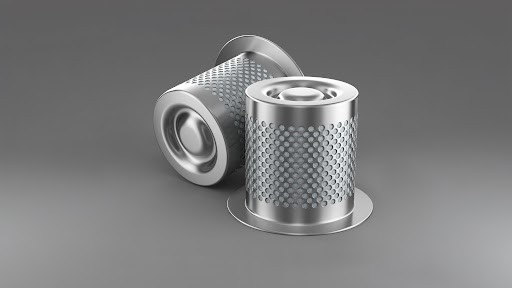
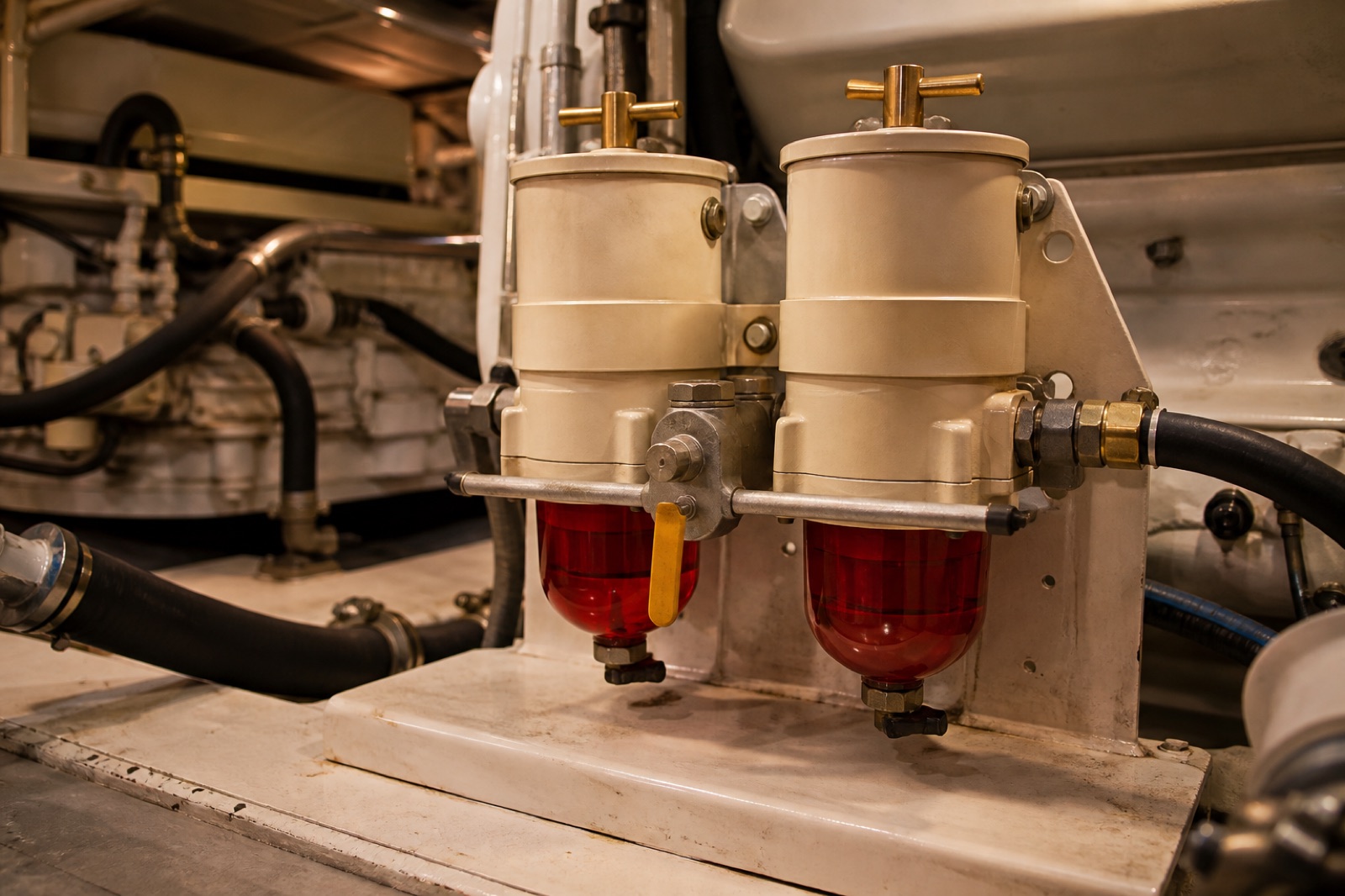
The primary Racor stage is the workhorse of the filter train. Racor 1000-series, 2000-series and Turbine-series units are the marine-industry standard for fuel-water separation on distillate and low-viscosity residual applications, and Racor 4120R and 4500R families cover higher-flow OSV and merchant applications. Typical primary rating is 30 µm nominal with 99% water removal to ISO 16332 for gravity-drop water separation, plus vacuum-gauge or DP-transducer plugging indication.
The secondary fine filter is engine-mounted, typically 5 µm nominal with a β200 rating at 4–6 µm to ISO 19438, and typically supplied by the engine OEM under Racor, Fleetguard or MAN private label. On MAN B&W two-stroke slow-speed engines the secondary is a duplex arrangement so filter change can happen without shutting down; on medium-speed four-stroke Wärtsilä and Caterpillar marine engines, a duplex or triplex layout is standard.
The on-engine last-chance filter on modern electronically-controlled marine diesels (MAN ME-series, Wärtsilä RT-flex, Caterpillar MaK M43) is often integrated into the injector or the injection pump inlet, and it is not user-serviceable in the normal sense, it is inspected and replaced at overhaul. Its existence is what makes upstream cat-fine removal at the Racor stage non-negotiable, because contamination that reaches this last-chance filter causes it to plug and forces the engine off-load.
For a working walk-through of primary and secondary sizing on Gulf-flagged tonnage, the marine fuel filtration best practices for UAE ports piece has the field data. The top filter brands available in Dubai piece and where to buy Fleetguard filters in the UAE piece cover the procurement side of the same architecture.
Racor product families for UAE waters
Racor is the dominant marine fuel-water separator brand for Gulf-operating tonnage from tugs and OSVs through to merchant coasters and cruise ferry duty. Four family designations cover most UAE applications.
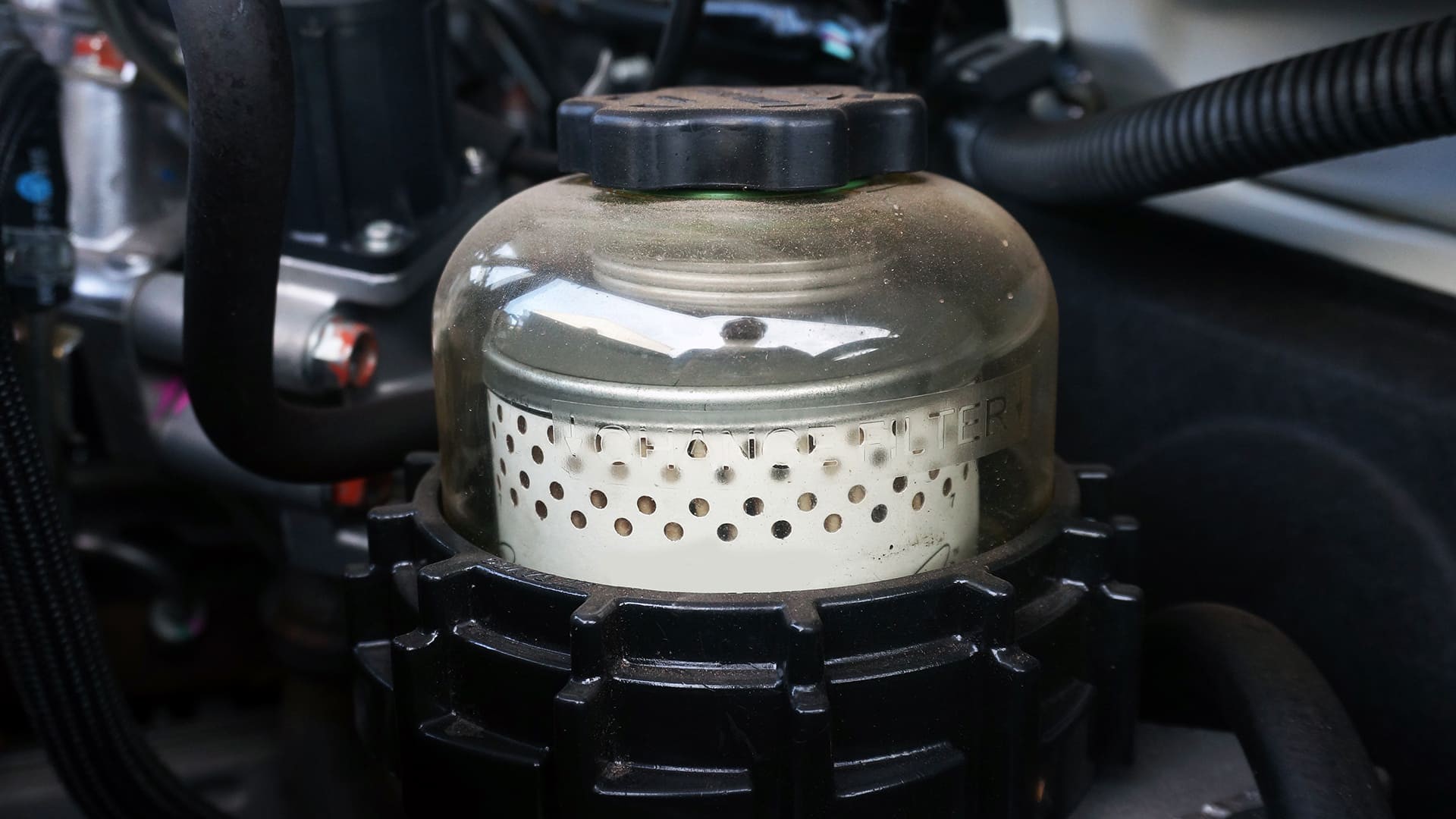
Racor 1000-series (1000MA, 1000MAM, 1000FG, and turbine variants) is the workhorse for tugs, workboats, patrol craft and small OSVs. Flow rating 60–380 gph depending on element choice. Nominal 30, 10 or 2 µm elements available; typical primary duty runs 30 µm with a see-through bowl for visual water check. Common part numbers we stock at Aweer include 2010PM (30 µm), 2010SM (10 µm), 2010TM (2 µm). The Racor product line page has the fuller inventory.
Racor 2000-series covers larger workboats, small merchant tonnage and larger OSVs. Flow rating up to 720 gph on single-element housings and higher on duplex arrangements. Element compatibility is broader, Aquabloc II hydrophobic media is the standard for water-emulsion removal, and heavier fuels above 700 mm²/s viscosity need appropriate low-restriction elements. This family is the most common single-mode primary on UAE Fujairah-based OSV fleets.
Racor Turbine-series (75/500 Turbine, 900/1000 Turbine) is the pressure-vessel arrangement with a spring-loaded T-handle for tool-free element change. The Turbine geometry provides a first-stage cyclonic water separation before the coalescing filter media, which improves free-water removal on high-water-content bunker deliveries. Standard on many chief-engineer preference lists precisely because the change-out procedure is fast under bad-fuel conditions.
Racor 4120R and 4500R are the higher-flow families for merchant tonnage and larger OSV duties, running duplex or triplex housings and flows above 1,500 gph. Coalescing-media element choices in the 2 µm and 5 µm ranges are available for secondary duty, and the duplex housing allows online element change.
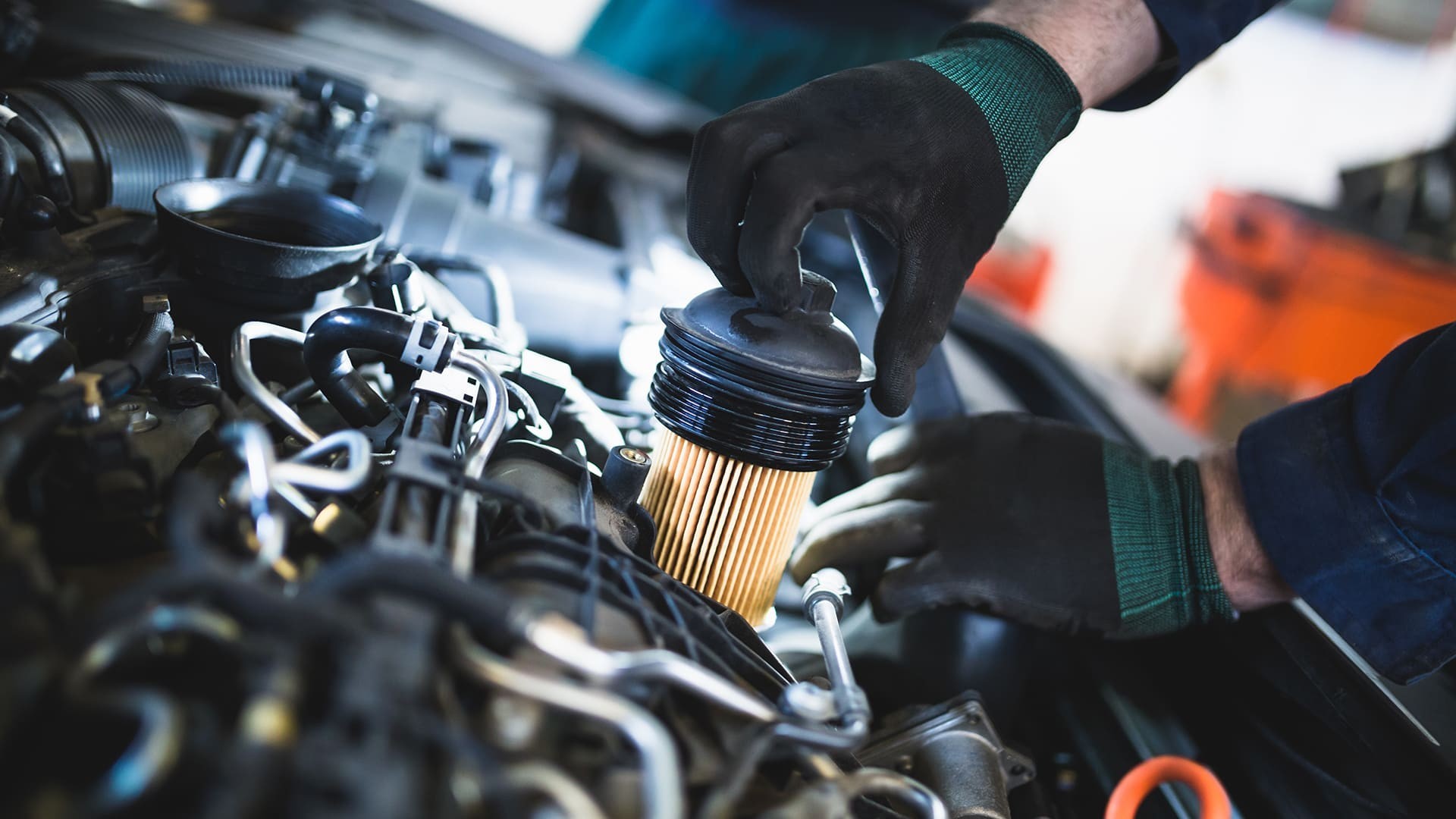
Interval management on Racor primary elements is DP-triggered, 15 in Hg (roughly 50 kPa) vacuum on the vacuum gauge is the standard change-out point, or immediately on water-in-fuel sensor trip regardless of DP reading. Deferring beyond 15 in Hg on a Racor primary is the typical field mistake that leads to the engine going off-load during a bunker-quality event.
Parker fuel and hydraulic filtration on marine platforms
Parker Hannifin's marine product line, sold under both Parker and Racor branding since Parker's acquisition of Racor in 1985, extends beyond fuel filtration into hydraulic and lube filtration for deck machinery, steering systems and thruster hydraulics. On typical UAE-based OSV, tug and merchant tonnage, Parker product families that appear alongside Racor fuel elements include:
Parker Turbine and Fulflo fuel-water separators: the direct-fit alternatives to Racor on new-build tonnage where Parker Turbine is the specified primary. Element cross-references are documented across the two lines and stocked at Aweer.
Parker Hydraulic filters on marine hydraulic systems (steering, thruster, deck-machinery) mirror the industrial and mobile-equipment product families covered in the hydraulic system cleanliness guide, return-line and pressure-line filters at β200 or better matched to the target ISO 4406 code for the specific circuit.
Parker lube filtration: Parker Racor lube filter cartridges are used on some medium-speed marine diesel platforms alongside Fleetguard and OEM-branded elements. Cross-referencing is done to ISO 16889 test method with published beta ratio, matching the same discipline the Cummins/CAT/Perkins genset guide applies to shore-based diesel.
Parker's marine service and support library publishes the specific application matrices for each product family; we hold the reference data at Aweer and cross-reference against Racor and Fleetguard alternatives where the customer specifies aftermarket. The oil filter category covers the lube filtration procurement side.
Air and crankcase filtration on marine diesels
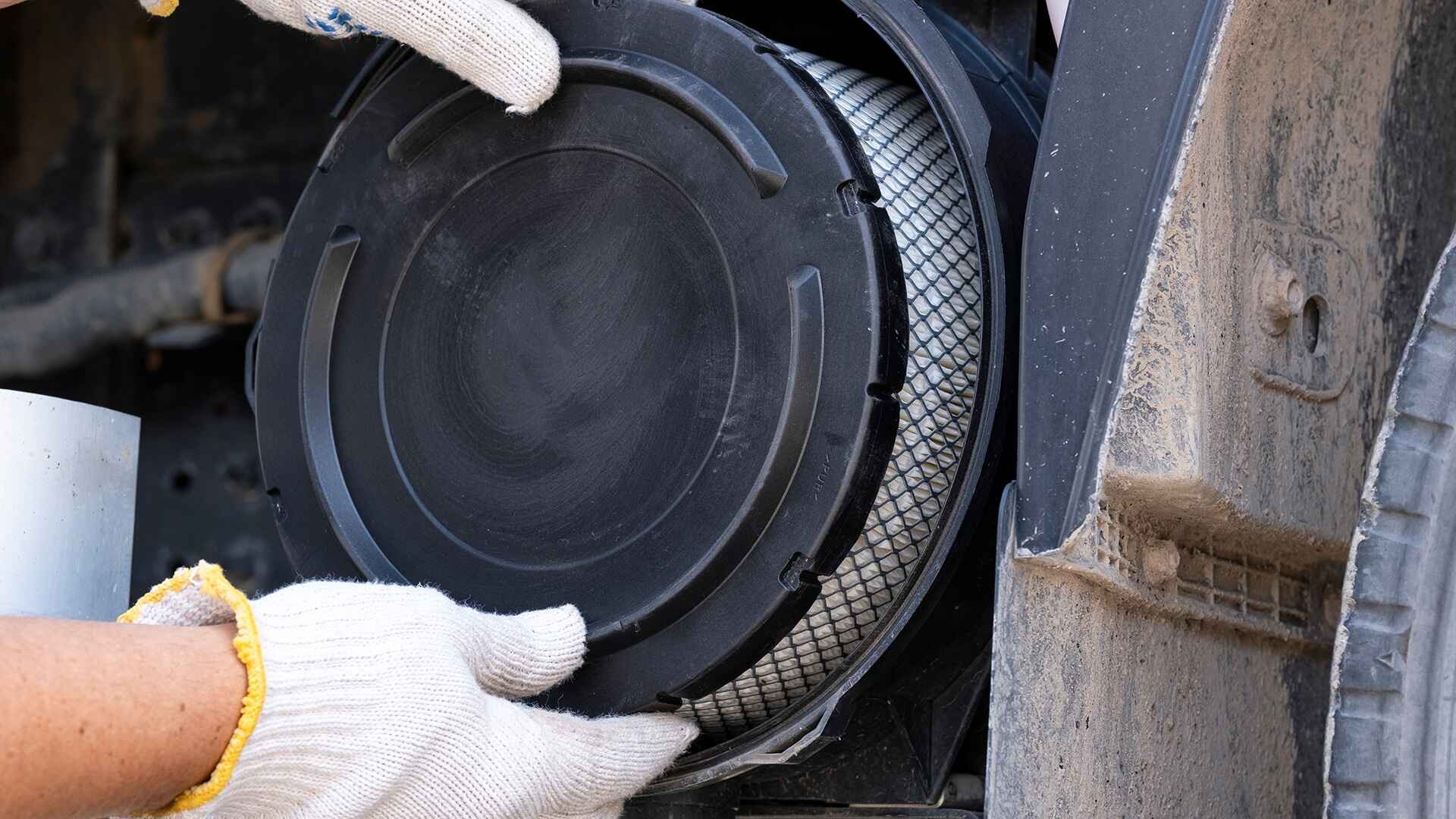
Marine diesel air filtration is a lower-stakes filtration surface than fuel or lube, most marine diesel intakes draw from an engine-room environment that is already relatively clean of large particulate, and the intake filter is typically a metal-mesh wire cloth or panel-media unit rated at 40–100 µm. It exists to catch large debris (bolts, tools, rags dropped near the intake) rather than to fine-filter. Interval is condition-based on visual inspection and DP; typical service is annual or at scheduled dry-dock.
Crankcase ventilation filtration is the more critical air-side element. Marine diesels breathe roughly 0.5–1% of intake flow through the crankcase breather, and oil-mist carryover is what fouls turbocharger inlets, ruins after-cooler cores and, on modern EPA Tier 3 and IMO Tier III platforms, contaminates the SCR catalyst downstream. Coalescing crankcase ventilation filters (Racor CCV series, Parker CCV) capture oil mist with high efficiency and are a standard specification on Tier 3 marine platforms.
Return-oil filtration on marine diesels follows the same protocol as shore-based industrial diesel, full-flow lube filter matched to OEM spec with a bypass filter on larger platforms, oil-analysis-driven condition-based change intervals. The industrial filter maintenance guide walks through the sampling schedule and trending logic that applies equally to marine lube systems.
"The mistake I see on marine lube is treating the LF9080 or the equivalent Racor element as a 500-hour item without oil analysis," says Vishal Kapoor, engineering superintendent at a UAE-flagged coaster operator. "In Gulf ambient conditions with the fuel we're burning, 250 hours is the real interval. Oil analysis confirms it."
Operating condition specifics: Dubai, Fujairah, Khor Fakkan
Fujairah anchorage is a bunker-only port for most calls, so vessel operations focus on rapid bunker uptake, fuel testing during transfer, and filter-element availability for any post-bunker plugging events. The 4,500-vessel-per-year traffic makes Aweer-based same-day spares availability across the Racor line operationally significant, a vessel that has to wait 48 hours for a primary element loses charter revenue immediately.
Khor Fakkan is a container port with regular liner rotations, so fuel filtration procurement runs alongside scheduled maintenance cycles. Availability of the standard Racor 1000-series and 2000-series primary elements plus MAN B&W and Wärtsilä secondary cross-references is the procurement priority. The construction fleet filter maintenance schedule piece describes the analogous logic for shore-based scheduled maintenance planning.
Dubai (Port Rashid, Jebel Ali) covers cruise, container, general cargo and OSV traffic. Racor primary and Fleetguard secondary demand is high, and the Jebel Ali filter supplier node is the local dispatch point. Marine hydraulic filtration on OSV deck machinery ties back to the industrial hydraulic filter category with the same beta-ratio-and-micron discipline.
Environmental variables affect all three ports. Ambient sea-water temperature runs 20°C in January to 35°C+ in August in the Gulf, the highest recorded sea-surface temperatures anywhere in the global oceans (Emirates Nature-WWF Gulf Sea Surface Temperature Bulletin, 2023). Fuel-oil viscosity handling on the ship-side has to account for that higher ambient temperature, which affects heater sizing on residual grades but doesn't change filter selection. Humidity above 80% in summer months affects filter storage, sealed and desiccant-packed spare-element storage at the Aweer warehouse is what keeps the media dry between manufacture and installation. The water filtration for UAE desalination plants piece covers the shore-side of Gulf water treatment for context on ambient conditions.
FAQ
Where do you stock marine filtration for UAE ports? On marine filtration solutions. This guide is the ISO 8217 and Racor / Parker walk-through. That page is the Aweer inventory.
What is ISO 8217 and why is it the reference for UAE marine fuel? ISO 8217:2024 is the international marine fuel specification for distillate (DMX, DMA, DMZ, DMB) and residual (RMA through RMK) grades. It's adopted in the UAE via UAE.S GSO ISO 8217 and is the contractual reference in bunker purchase agreements at Fujairah, Khor Fakkan and Jebel Ali. Limits on sulfur (0.50% global, 0.10% ECA), water (0.50% v/v residual), catalytic fines (60 mg/kg RMG), density, viscosity and flash point govern every bunker stem.
Why do Fujairah bunkers have a cat-fine problem? Catalytic fines are aluminium-silicate abrasive particles that end up in residual marine fuel through the refinery FCC (fluid catalytic cracking) process. Bunkering blend variability at large hub ports means over 4% of Fujairah stems have historically exceeded the 60 mg/kg ISO 8217 limit at the manifold (Veritas Petroleum Services Q4 2023 Fuel Quality Bulletin). Well-managed centrifugal separators plus proper Racor secondary filtration are what bring the injector-inlet loading down to the 10–15 mg/kg range where liner wear is manageable.
What is the standard marine fuel filtration architecture? Four stages: centrifugal separator on the settling tank output, primary Racor or Parker fuel-water separator on the transfer line, engine-mounted secondary fine filter, and on-engine last-chance filter integrated into the injection system on modern platforms. Each stage has a specific job, no stage substitutes for another. Primary rated 30 µm with 99% water removal to ISO 16332; secondary rated 5 µm with β200 or better at 4–6 µm to ISO 19438.
When should I change a Racor primary fuel filter element? On the earlier of two triggers: vacuum gauge reading 15 in Hg (roughly 50 kPa) at operating flow, or water-in-fuel sensor trip regardless of DP. Both triggers should be checked on every watch during passage. Deferring past 15 in Hg on a Racor primary is the typical field mistake that leads to the engine going off-load during a bunker-quality event or a post-fuel-change contamination excursion.
Which Racor family should I specify for a Gulf-operating OSV? Racor 2000-series or Racor Turbine-series are the typical primary choices for OSV duty in the Gulf, sized to 20–50% above peak engine fuel-consumption flow to allow re-circulation. Aquabloc II hydrophobic media is the standard for water-emulsion handling in Gulf-bunker service. The marine filtration category has the fuller product-selection matrix.
Are Racor and Parker fuel filter elements interchangeable? On many housings yes, Parker acquired Racor in 1985 and the product lines share many housings and element codes across the two brands. Cross-references are documented at the specific part-number level, matching beta ratio and micron at the same test standard (ISO 16332 for water removal, ISO 19438 for particulate). Our Aweer inventory carries both brands with authorized cross-reference documentation on every dispatch.
How is marine air filtration different from shore-based diesel? Marine air filtration is lower-stakes than shore-based diesel, the engine-room environment is already relatively clean of large particulate, and intake filters are typically 40–100 µm metal-mesh or panel-media units. The critical air-side element on marine diesels is crankcase ventilation filtration (Racor CCV or Parker CCV coalescing units) which prevents oil-mist carryover from fouling turbochargers, aftercoolers and, on modern IMO Tier III platforms, SCR catalysts.
What is a centrifugal separator and does it replace the Racor filter? A centrifugal separator (Alfa Laval, GEA Westfalia, Mitsubishi) uses centripetal force to separate water and higher-density solids from fuel oil. It handles bulk water and cat-fine removal on residual grades at flows 20–50% above engine consumption. It does not replace the Racor filter, it is upstream of it. Racor primary filtration is what catches the fine particulate the centrifuge misses and what protects the injection system in the event of a separator upset.
What documentation should come with marine filter spares? Certificate of conformity to the applicable ISO standard (ISO 16332 for water separation, ISO 19438 for particulate, ISO 5011 for air), the OEM part number cross-reference, and batch traceability for the ISM (International Safety Management) audit trail. Every marine filter dispatched from the Aweer warehouse across the UAE authorized network includes that documentation package.
Where can I get emergency marine filter spares in the UAE? 24-hour availability from the Aweer warehouse for Fujairah anchorage calls, Khor Fakkan and Dubai port operations. Dispatch runs through the Jebel Ali node for port operations and by direct delivery to Fujairah anchorage for vessel spares. The emergency filter sourcing across the 24-hour GCC piece describes the operational model.
How do I document filter substitutions on ISM-audited vessels? Every substitution captures the OEM part number, the aftermarket replacement, the governing test standard (ISO 16332 or ISO 19438), batch traceability and certificate of conformity. The record is retained in the vessel's planned-maintenance system for the ISM Code audit cycle and for the vessel's classification society (DNV, ABS, Lloyd's Register, ClassNK) survey. Our Aweer dispatch supplies the certificate-of-conformity side of that record.
Authoritative outbound references
- ISO 8217:2024 marine fuel specification
- IMO 2020 sulphur cap resolution MEPC.305(73)
- Veritas Petroleum Services Fuel Quality Bulletin
- Parker Racor marine fuel filtration library
- MAN Energy Solutions service letters library
- Alfa Laval marine separator product library
- ISO 16332 diesel fuel water separation test




 Facebook
 Instagram
 LinkedIn