By Meera Ajesh, Chief Operating Officer, ThinkFilter, Aweer warehouse, Dubai. Last updated 4 August 2026.
Industrial maintenance in the UAE has two problems that don't exist in a Munich workshop: temperature and dust. A Mussafah cement plant's baghouse pulse-jet cleaners see three times the loading of a Bavarian installation, and a Sajaa desalination auxiliary system's charge-air filter can dust-blind inside a shift during a March shamal. That reality is why maintenance schedules copied straight from an OEM manual quietly overspend on labour, underspend on filters, and still miss failures. This guide is the working playbook we hand across the Aweer counter to plant reliability engineers, fleet managers and MRO buyers who want the sampling logic, the condition-based replacement triggers, and the cost math behind each of those decisions.
Table of Contents
- Why calendar-based intervals fail in the UAE
- Oil sampling schedules that actually catch failures
- Condition-based replacement triggers by fluid type
- Air side: differential pressure, dust holding and the shamal factor
- Cleanroom and process filtration protocols
- The cost math: TCO of a filter change vs a bearing rebuild
- Documentation and audit trail for ISO 9001 and ISO 55001 sites
- FAQ
Why calendar-based intervals fail in the UAE
The default OEM change interval on most industrial filters assumes a temperate operating envelope: 25°C ambient, ISO 15/13/10 fluid cleanliness on install, PM10 loading around 20 µg/m³. That's Nuremberg. Aweer in July sits at 44°C ambient average with PM10 that has repeatedly crossed 500 µg/m³ during sandstorm events (Dubai Air Quality Index, DAQI historical data, 2022–2024). Push a hydraulic system that was designed for 50°C sump temperature to 68°C and the oil oxidation rate roughly doubles for every 10°C rise (Arrhenius rule of thumb, cited in Noria's Practical Handbook of Machinery Lubrication Analysis, 2018). Half the design margin on the filter's dirt-holding capacity is gone before the first calendar interval is up.
The consequence, quantified in multiple GCC reliability audits published through the Society for Maintenance and Reliability Professionals (SMRP), is that calendar-based programmes in the UAE deliver roughly 30–40% wasted filter spend (early replacements) and 10–15% catastrophic misses (elements that plug and bypass between scheduled changes). Neither is acceptable at industrial scale. Condition-based maintenance, filter changes triggered by measured differential pressure, oil analysis or hours-under-load, closes both gaps and is the baseline this guide assumes.
"Calendar intervals are for accountants, not reliability engineers," says Mahmood Al Zaabi, plant reliability lead at a Sajaa industrial park manufacturing group. "The filters on our compressed-air line saw 200% variance in life last year, some hit 4,000 hours, some plugged at 1,600. There's no calendar that survives that spread. Only the DP transducer knows."
The rest of this guide is organised around the measurement points that drive that decision: oil analysis for lubricant and hydraulic systems, differential pressure for air and gas, particle counts for cleanroom, and cost-per-operating-hour for the procurement audit.
Oil sampling schedules that actually catch failures
Oil analysis is the cheapest predictive test on an industrial site. A single sample analysed at a competent laboratory, spectrometric metals, ISO 4406 particle count, water by Karl Fischer, viscosity at 40°C and 100°C, TAN, costs roughly AED 60–90 in Dubai in 2026 and returns data on filter effectiveness, wear metal trending and contamination ingress. Yet SMRP survey data from its 2023 Body of Knowledge update indicates that fewer than 50% of Gulf industrial sites sample lubricants on a formal schedule.
The recommended sampling cadence for a UAE site tracks the criticality of the machine. Critical hydraulic and lube circuits, a paper machine, a crusher lube module, a turbocharger service tank on a genset larger than 1 MW, should be sampled every 250 operating hours or monthly, whichever comes first. Sub-critical systems (auxiliary pumps, gearboxes on non-production duty) run at 500 hours or quarterly. New oil should be sampled before it enters service, roughly 15% of new oil deliveries in the region fail ISO 4406 22/20/17 on receipt (Noria Middle East field data, 2020), which is dirtier than most systems want to see after 250 hours in service.
Samples have to be pulled from a live line through a probe or a properly flushed sample port, not from a drain plug or dipstick, or the data is worse than useless. Roughly 30% of samples pulled from drain plugs come back with false-positive silica readings from bottom-of-sump sludge (Chevron Global Lubricants field guidance, 2019). The way to catch this is to sample the same port, the same way, every time, then trend the numbers, not the absolute readings.
Trending is where the schedule earns its keep. A single ISO 4406 result of 19/17/14 is uninformative; a trend from 18/16/13 in January to 19/17/14 in February to 21/19/16 in March tells you the filter is losing efficiency and the interval needs to shorten. That trending logic is what powers the fleet filter maintenance checklist and the filter maintenance importance for UAE climate piece.
Condition-based replacement triggers by fluid type
Hydraulic filters replace on the earlier of two signals: differential pressure at 80% of the bypass valve setting (measured across the element at operating temperature), or ISO 4406 code moving two range numbers coarser than the machine target. On a Cat 336 excavator running 20/18/15 as a target, that trigger fires at 22/20/17. Waiting for the visual indicator to reach bypass is late, by that point the element has been in bypass intermittently for weeks and the pumps have already seen unfiltered oil. Our signs a hydraulic filter needs replacing piece walks through the field indicators.
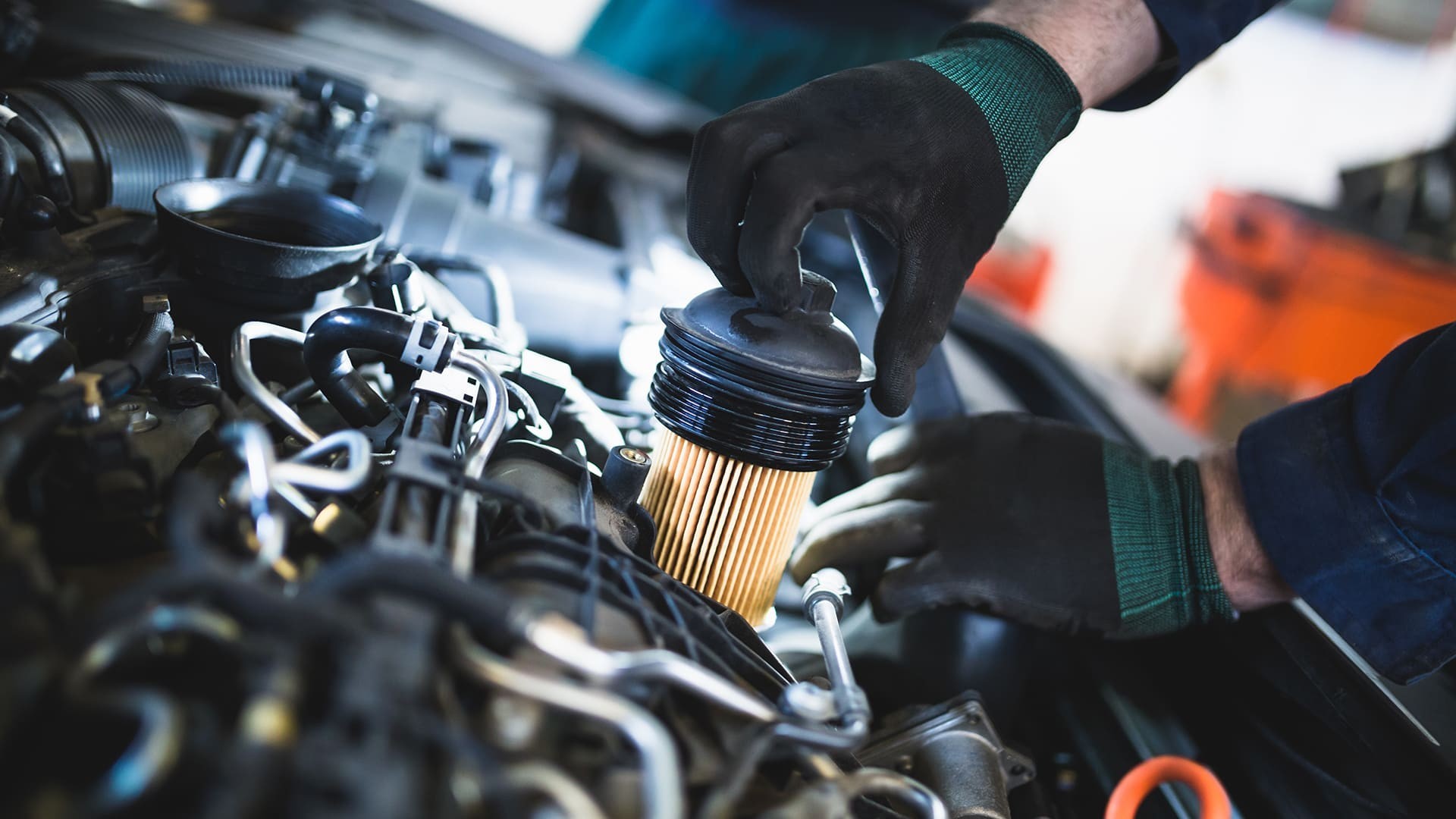
Lube filters on diesel engines replace on oil analysis trigger, soot loading above 1.5% by weight for over-the-road heavy-duty, iron trending above 100 ppm change per 250 hours, or oxidation index above 25 abs/cm, rather than kilometres or hours alone. Fleetguard's Stratapore synthetic media on the LF9080 platform typically holds 1.5% soot without bypassing; cellulose-only elements bypass at around 0.8%. That's the practical difference between synthetic and cellulose media covered in synthetic vs cellulose filter media.
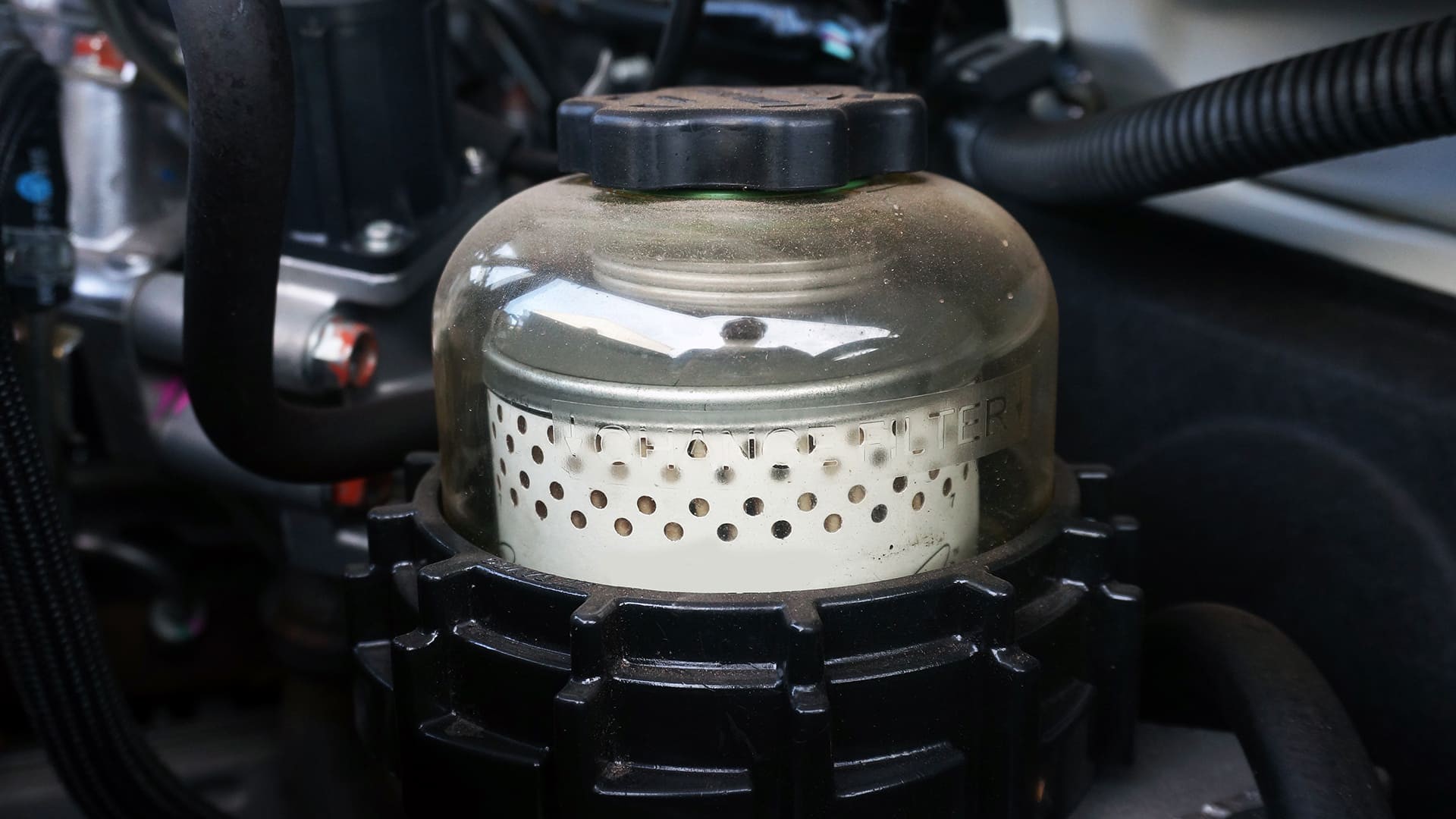
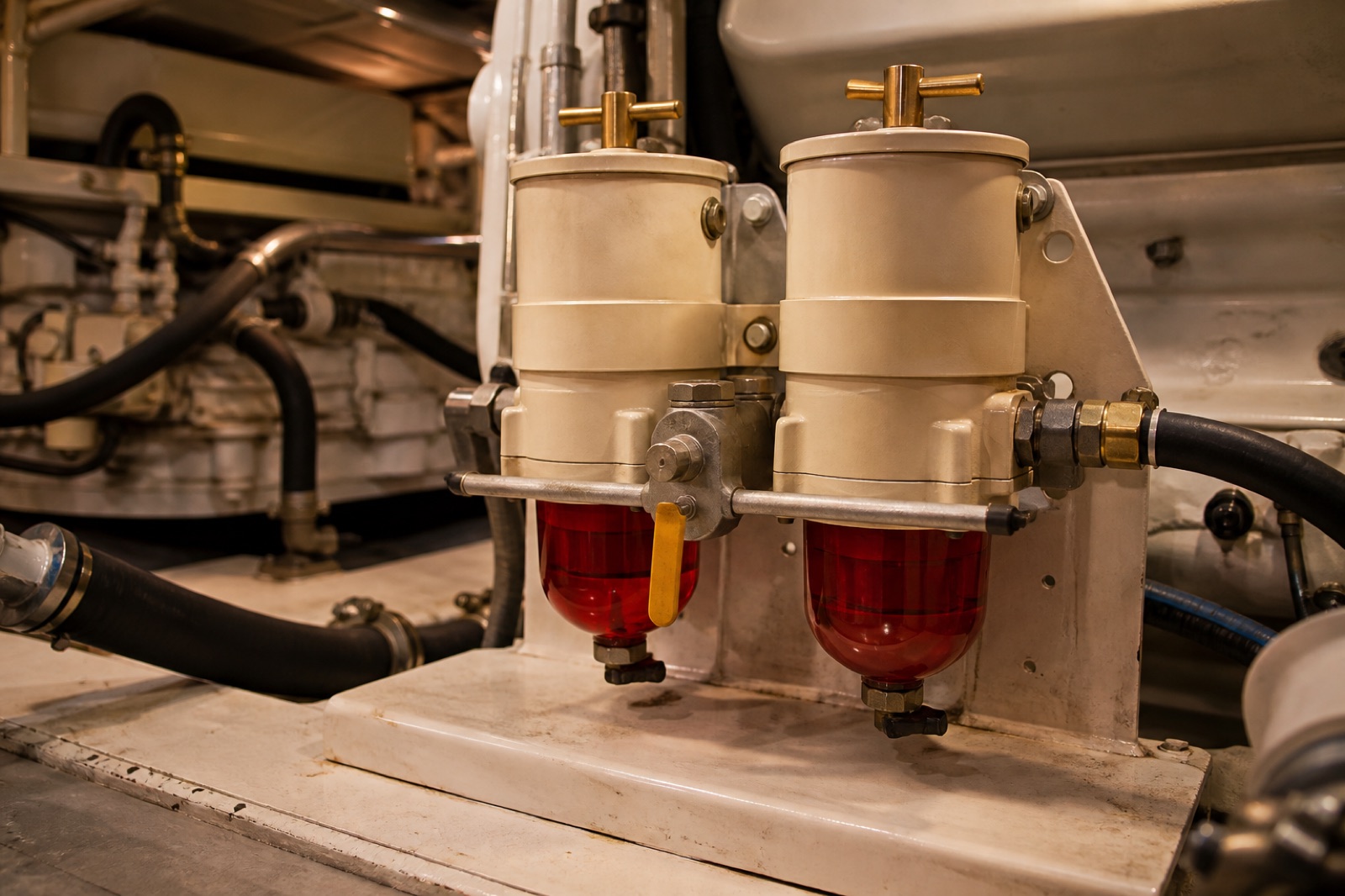
Fuel filters replace on differential pressure (water in fuel sensor firing on the primary fuel-water separator counts as a hard replacement trigger regardless of hours), or when fuel sample water content exceeds 200 ppm at the day tank. UAE bunker and road-diesel supply variability makes fuel filtration one of the highest-return maintenance investments; the fuel-water separator guide covers the primary-secondary logic.
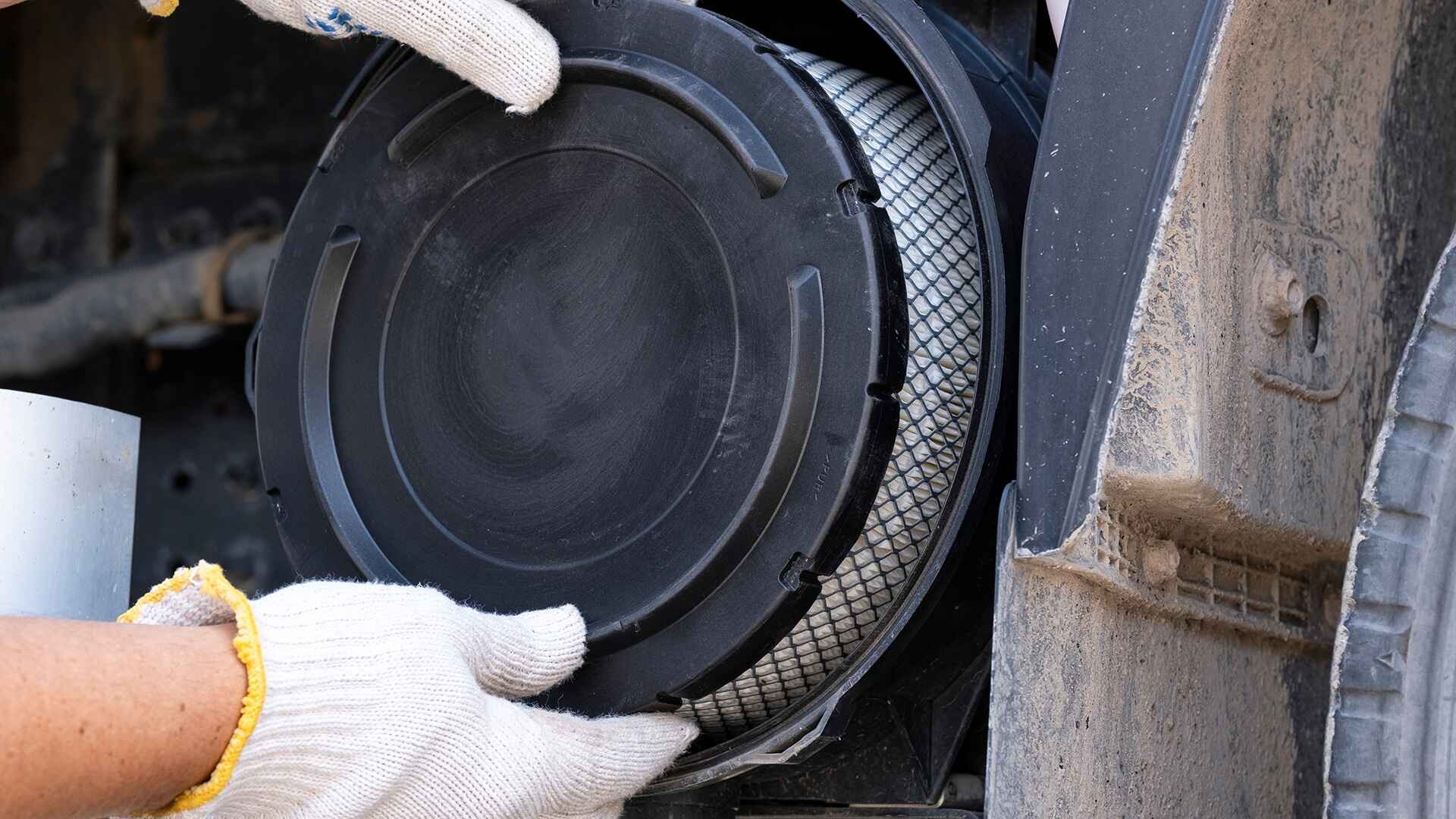
Air filters on diesel engines replace on restriction gauge reading, 25 inches H₂O for most heavy-duty naturally aspirated, 30 inches H₂O for turbocharged, rather than on hours or visual inspection. During shamal season, air filter change intervals in Al Quoz and Ras Al Khor workshops routinely compress from 500 hours to 150–200 hours; the sandstorm heavy equipment air filter protection piece has the field data.
"The two triggers that pay for themselves in a week are the hydraulic DP transducer and the air-intake restriction gauge," says Nikhil D'Souza, maintenance manager at a Jebel Ali logistics fleet. "Everything else follows those two. We stopped changing air filters on hours the day we installed proper restriction gauges, filter spend dropped 22% in the first quarter and we had zero turbocharger failures for 14 months."
Air side: differential pressure, dust holding and the shamal factor
The airside condition-based rule is straightforward: replace at the OEM's terminal pressure drop, or at the point where the pressure drop's contribution to fan energy cost exceeds the new-filter cost. Both matter in the UAE.
Terminal pressure drop for MERV 13 HVAC bag filters is typically 400 Pa; for MERV 14 rigid filters, 450 Pa; for HEPA H13 terminal filters, 600 Pa (Camfil technical datasheet, 2023). Riding a MERV 14 filter to 450 Pa in a Dubai commercial building at 8,760 hours per year burns roughly 4,700 kWh more fan energy per air handler compared to changing at 350 Pa (calculated at 1.5 kW additional fan draw, DEWA slab tariff of AED 0.44 per kWh). That's AED 2,068 in avoidable energy cost per air handler per year, enough to change every filter twice.
On the industrial dust-collection side, differential pressure across a baghouse or cartridge collector should sit in a 1.0–1.5 kPa working range with cleaning cycles pulsing to hold it there. A steady climb above 2 kPa signals hygroscopic loading (very common in coastal Sharjah and Umm Al Quwain sites with high humidity), and needs a filter change rather than more aggressive pulse cycling, which will just accelerate media wear.
The shamal factor is not a rounding error. Dubai Municipality air quality data from March 2023 recorded PM10 peaks over 900 µg/m³ across a 72-hour storm (Dubai Environment Agency AQI history), and 24-hour running averages routinely cross 300 µg/m³ during the March–May window. Air filter life in that period compresses to 30–40% of its off-season figure across the air filter category. The pragmatic response is a pre-filter stage, MERV 8 pleated pre-filter in front of a MERV 13 final, to protect the more expensive terminal element. Details are in the dusty-environment air filter replacement piece and the commercial-building playbook at HVAC air filtration for commercial buildings in the UAE.
Cleanroom and process filtration protocols
Cleanroom filtration in the UAE, pharmaceutical fill-finish in Dubai Science Park, semiconductor sub-fab in Khalifa Industrial Zone Abu Dhabi (KIZAD), medical device assembly in Dubai Industrial City, runs under ISO 14644-1:2015 airborne particulate cleanliness classes. A Grade A / ISO 5 fill zone requires no more than 3,520 particles ≥0.5 µm per cubic metre. Meeting that class relies on HEPA H14 (99.995% at MPPS) or ULPA U15/U16 filters as the terminal stage.
Cleanroom filter maintenance is a different discipline from industrial airside. Filters are integrity-tested on install (DOP or PAO aerosol challenge per IEST-RP-CC034.3), leak-scanned with a photometer or particle counter along every gasket seam, and re-tested at least annually. Replacement is triggered by integrity failure or by pressure drop reaching the design maximum, never by calendar. Documentation is part of the ISO 9001 quality system and Dubai Health Authority (DHA) or Ministry of Health and Prevention (MoHAP) audit trail for regulated facilities.
Process filtration, bag filters on paint booths, cartridge filters on chemical process streams, coalescing filters on compressed air, follows the same condition-based logic but with the added trigger of downstream product quality. A coalescing air-line filter on a food-grade compressed air system is replaced on the earlier of DP > 0.7 bar or downstream oil-content test above ISO 8573-1 Class 2 (0.1 mg/m³). The nanotechnology filters overview covers newer media families being specified into UAE cleanroom and process applications.
The cost math: TCO of a filter change vs a bearing rebuild
Every industrial filter maintenance conversation ends in the same place: what does this change cost, and what does it save? The math is more forgiving than most CFOs believe.
Take a typical Cat 966 wheel loader on a Ras Al Khor aggregate site. The main return hydraulic filter (aftermarket cross-reference to Cat 4T-6788, Hydac equivalent) costs around AED 180. Labour to change it: 20 minutes, roughly AED 40 loaded. Total change cost: AED 220. A single hydraulic pump failure on the same machine, driven by ISO 4406 excursion past 22/20/17 for a sustained period, runs AED 18,000–24,000 for the pump plus AED 6,000 for the associated system flush, cooler and lines contamination cleanup. That is a break-even at roughly one avoided pump failure per 100 changes, or about 1% failure risk offset. Every field study SMRP has published on hydraulic reliability puts the actual risk reduction from a properly-maintained CBM programme at 5–8x that break-even point.
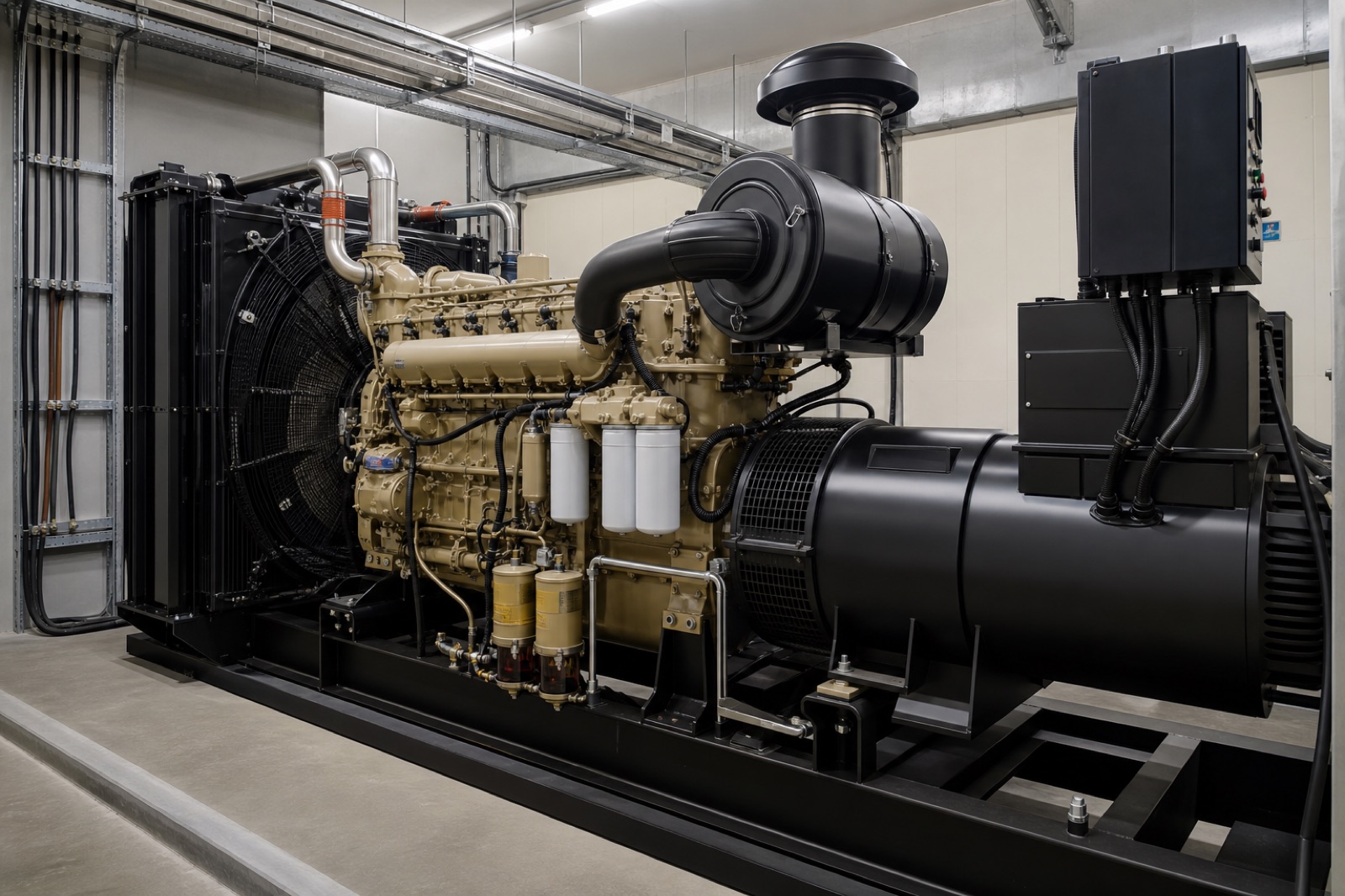
The genset side is even sharper. A Cummins C1100D5 lube filter (Fleetguard LF9080) costs around AED 95; the fuel filter (FF5320) around AED 65. A single turbo failure on the same platform runs AED 22,000–28,000, and an injector rebuild triggered by dirty fuel runs AED 3,500 per hole plus labour. Deferring changes on either side to save AED 160 per service interval is the classic penny-wise pound-foolish call. The true cost of cheap filters for UAE fleets piece runs the full numbers with published Cummins service data.
"We ran the numbers on our own fleet, 84 heavy trucks across Al Quoz and Mussafah, and cheap filters cost us AED 340,000 in un-planned engine downtime in one year," says Farah Suleiman, fleet director at a UAE logistics group. "The saving on the filters themselves was AED 62,000. It's not close. We only stock OEM-equivalent from authorized channels now."
Cost math also has a soft side: audit exposure. A site running documented CBM against ISO 55001 asset management benchmarks is materially easier to insure and audit than one running calendar-only maintenance. That translates to insurance premium reductions of 5–12% at renewal on capital-intensive plants (Marsh Middle East risk engineering benchmarks, 2022 report). It doesn't show up on the maintenance budget line; it shows up in the CFO's insurance line and it is real money.
Documentation and audit trail for ISO 9001 and ISO 55001 sites
Every filter change on an ISO 9001 or ISO 55001 site needs a work-order record capturing the machine tag, the OEM part number, the aftermarket substitute (with cross-reference documentation), the trigger that fired the replacement (DP reading, oil-analysis result, hours-under-load), the technician, and the disposal manifest for the used element. That's not paperwork for its own sake; it is the artefact that survives an audit and the data source that lets the reliability engineer trend interval performance across the fleet.
Practical formats vary by site, CMMS entries in SAP PM or IBM Maximo, or a paper log at smaller MRO sites, but the fields don't change. On a Dubai Municipality-inspected industrial facility, the sustainability recycling of oil filters in the UAE piece covers the used-filter disposal side, which has become a formal requirement under Dubai Municipality's Waste Management Regulation No. 40 of 2018.
Our authorized inventory model at Aweer and across the UAE, Abu Dhabi, Sharjah, Jebel Ali, Mussafah, Sajaa, Al Ain, includes the cross-reference and certificate-of-conformity documentation on every dispatch precisely so that an ISO 9001 audit trail is intact from stockroom receipt through installation. The construction fleet filter maintenance schedule piece has a worked example for a heavy-equipment fleet, and the filter maintenance for agriculture equipment piece adapts the same framework for Al Ain and Northern Emirates farms.
"The audit trail is the CBM programme, in a real sense," says Deepa Nair, ISO 9001 lead auditor consulting to a KIZAD industrial park. "Any site can claim they're on condition-based maintenance. The ones that can show me the DP reading that triggered the change, the oil analysis that supported it, and the cross-reference that documented the substitute, those are the sites we pass in one visit."
FAQ
How often should I sample oil in a critical hydraulic system? Every 250 operating hours or monthly, whichever is sooner. Sub-critical systems can move to 500 hours or quarterly. Sample from a live line through a probe or properly flushed port. Trend the numbers rather than reading each result in isolation, a two-range-code shift in ISO 4406 over 500 hours is a stronger failure predictor than any single absolute reading, and it triggers a filter change well before differential pressure would signal the same problem.
What differential pressure should trigger a hydraulic filter change? Change on the earlier of two triggers: DP reaching 80% of the bypass valve setting at operating temperature, or ISO 4406 code moving two range numbers coarser than the machine target. Waiting for the visual indicator to signal bypass is late, the element has usually been in intermittent bypass for weeks by then, and the pump has already seen unfiltered oil. Install proper transducers rather than relying on visual gauges alone.
Is calendar-based maintenance ever appropriate? Yes, for very low-criticality or standby equipment where instrumentation cost cannot be justified. A small compressor on an office backup, a diesel fire pump run monthly for 30 minutes, calendar changes at the OEM interval are defensible. Anything running production duty, revenue-earning hours, or safety-critical service (hospital gensets, tunnel ventilation) should be condition-based, because the cost of a missed failure exceeds the cost of the sensors many times over.
How do UAE sandstorms change air filter intervals? Interval compression during shamal season (March–May) is severe: 30–40% of off-season life is typical, and single-event storms can dust-blind a heavy-equipment air filter inside 40 hours. The operational response is a pre-filter stage, MERV 8 pleated pre-filter in front of the MERV 13 final on HVAC, or a pre-cleaner and dry-side wrap on heavy equipment intakes, plus daily restriction gauge readings during storm periods.
What is the cost break-even for CBM vs calendar maintenance? On any hydraulic system worth more than AED 15,000 to repair, the break-even is roughly one avoided major failure per 100 CBM interventions. Published SMRP field data puts actual failure-avoidance from a properly-maintained CBM programme at 5–8x that break-even. Insurance premium reductions of 5–12% at renewal on capital-intensive plants add another layer of return that doesn't show on the maintenance budget line.
Do I need to document every filter change? On any ISO 9001 or ISO 55001 site, yes. The work-order record should capture machine tag, OEM part number, aftermarket substitute with cross-reference documentation, replacement trigger (DP, oil analysis, hours), technician, and disposal manifest. On Dubai Municipality-inspected facilities, disposal manifests are required under Waste Management Regulation No. 40 of 2018. The sustainability piece covers the disposal side.
How is cleanroom filter maintenance different? Cleanroom filters are integrity-tested on install (DOP or PAO aerosol challenge per IEST-RP-CC034.3), leak-scanned along gasket seams with a photometer or particle counter, and re-tested at least annually. Replacement is triggered by integrity failure or by design-maximum pressure drop, never by calendar. Documentation is part of the ISO 9001 quality system and the DHA or MoHAP audit trail for regulated facilities in the UAE.
Which brands do you stock for industrial maintenance? We stock authorized inventory across Fleetguard, Donaldson, Baldwin, MANN, Hydac, Parker, and Racor, with same-day dispatch from the Aweer warehouse to the wider UAE network. Every dispatch includes the cross-reference documentation and certificate of conformity for the ISO 9001 audit trail.
Can I run cheap aftermarket filters and just change them more often? No, and the field data is unambiguous on this. Cheap aftermarket elements typically have lower beta ratios at the same nominal micron, a "β75 at 20 µm" filter passes roughly four times the particles a "β200 at 20 µm" filter passes. Faster changes don't fix that, because the damage is done every operating hour the low-beta element is in service. The break-even runs against cheap elements at almost any usable failure cost.
Where can I get emergency filter stock in the UAE outside normal hours? Our authorized network runs 24-hour availability for critical dispatches, the emergency filter sourcing across the 24-hour GCC piece explains the model. Same-day dispatch is standard from Aweer during operating hours; after-hours emergency stock draws from the Jebel Ali and Mussafah node depending on the specific line item and delivery point.
How does this apply to a small workshop with only 4–5 machines? The same triggers apply, scaled down. A small workshop can run oil sampling quarterly on the largest hydraulic circuit, install a restriction gauge on each air-intake, and keep a paper log of DP and hours at each change. Even minimal instrumentation captures the two big returns, avoided pump failures and turbocharger events, that drive the cost math. The instrumentation and sampling pay back inside the first year on any facility running more than a few thousand operating hours annually.
Authoritative outbound references
- SMRP Body of Knowledge, Reliability and Maintenance
- Noria Machinery Lubrication technical library
- ISO 55001:2014 Asset management, management systems
- ISO 14644-1:2015 Cleanrooms and associated controlled environments
- Cummins Fleetguard technical service bulletins
- Donaldson filter service and support library
- Chevron Global Lubricants technical resources




 Facebook
 Instagram
 LinkedIn