By Meera Ajesh, Chief Operating Officer, ThinkFilter, Aweer warehouse, Dubai. Last updated 27 August 2026.
A diesel genset in the UAE has a harder life than the datasheet admits. It backs up a hospital in Al Barsha on a 47°C afternoon, kicks in when a DEWA substation trips during a July storm, and holds power on a Khalifa Port container-handler through a shamal that has PM10 above 400 µg/m³. Filtration is what keeps that machine on load. When a Cummins C1100D5, a CAT 3512, or a Perkins 4008 goes down, it is almost always a filter conversation before it is a fuel-injection conversation.
If you need the stock we hold for hospitals, data centres, and plants, start on the power generation filtration page. This guide is the sequence. That page is the inventory.
This guide is the working walk-through of fuel, air and oil filtration for UAE genset operators, with the platform-specific quirks that trip up procurement teams and workshops most often.
Table of Contents
- Why UAE gensets live or die on filtration
- The fuel-air-oil sequence: how the three sides interact
- Fuel filtration: primary, secondary and the water problem
- Air filtration: pre-cleaners, restriction gauges and sandstorm response
- Oil filtration and lube analysis
- Cummins platform specifics: QSK, QSX, C-series
- Caterpillar platform specifics: C-series, 3500-series
- Perkins platform specifics: 1100, 2500, 4000-series
- FAQ
Why UAE gensets live or die on filtration
Three environmental factors dominate every UAE genset filtration conversation. Ambient temperature routinely crosses 45°C in Dubai and Abu Dhabi in July and August (National Center of Meteorology, 2025 annual summary), which pushes intake air density down by roughly 12% versus ISO 3046 rating conditions of 25°C. Airborne PM10 in Dubai has averaged around 132 µg/m³ over the past decade against the WHO annual guideline of 15 µg/m³ (WHO Global Air Quality Guidelines, 2021). And the region's diesel supply, while broadly compliant with UAE.S GSO 42 automotive diesel specification (10 ppm sulfur since 2014, per MoIAT gazette), still shows measurable variability in water content and particulate loading at the point of delivery, SGS Middle East fuel-quality surveys have reported 15–20% of retail diesel samples in the GCC failing an ASTM D975 water/sediment sub-test at the tank truck manifold (SGS GCC Fuel Quality Report, 2022).
The result is that a Cummins C1100D5 rated for 500-hour oil filter service in Europe often needs 250-hour intervals in Dubai; a CAT 3512 on a coastal Fujairah site sees fuel-water separator element life fall to 30% of the ISO service manual figure; and a Perkins 4008 backing a Sajaa data centre routinely double-shifts through air filters during the March shamal. Every one of those interval compressions is a filtration engineering problem, not a fuel or oil problem.
"The three biggest killers of GCC gensets, in order, are dirty fuel, dust ingestion and delayed oil changes," says Anand Krishnan, genset service manager for a Sharjah dealer group handling Cummins and Perkins. "You solve those three with the filter regime and the machine will outlast the enclosure."
That regime is what the rest of this guide lays out, tied to the UAE-relevant fuel filter category, air filter category, oil filter category, and the power generation industry page that pools our genset-application stock.
The fuel-air-oil sequence: how the three sides interact
The three filter loops on a diesel engine are not independent, and treating them that way is the most common maintenance mistake. Air side and fuel side each affect combustion; combustion quality drives soot loading in the oil; oil filtration efficiency determines how much of that soot ends up circulating through the bearings. Skip one side and the other two work harder.
Practical example: a Cummins QSX15 on a Mussafah container-terminal site with a plugging air filter starts to run rich, soot loading in the crankcase climbs from 0.8% to 1.9% over 300 hours, the LF9080 lube filter approaches its bypass DP, and by the time the operator reports smoky exhaust the turbocharger's inboard bearing has already seen abrasive wear. The AED 340 air-filter change that should have happened at 400 hours turned into a AED 26,000 turbo repair, a pattern the true cost of cheap filters for UAE fleets piece quantifies across fleet data. This is why the sequence matters as a system, not as three separate service items.
The order to think about it in is the order fuel and air combine in the engine: fuel side first (day tank quality, primary separator, secondary fine filter), air side second (intake ductwork, primary air filter, secondary safety filter, restriction gauge), oil side third (full-flow filter, bypass filter where fitted, sampling port, breather). Each side has condition-based triggers we cover next.
Fuel filtration: primary, secondary and the water problem
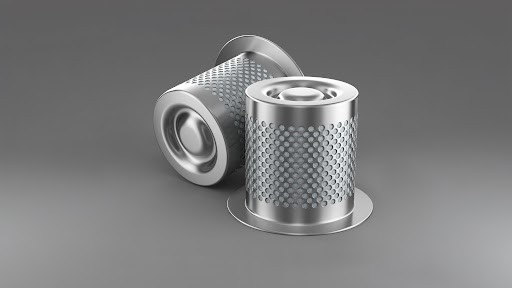
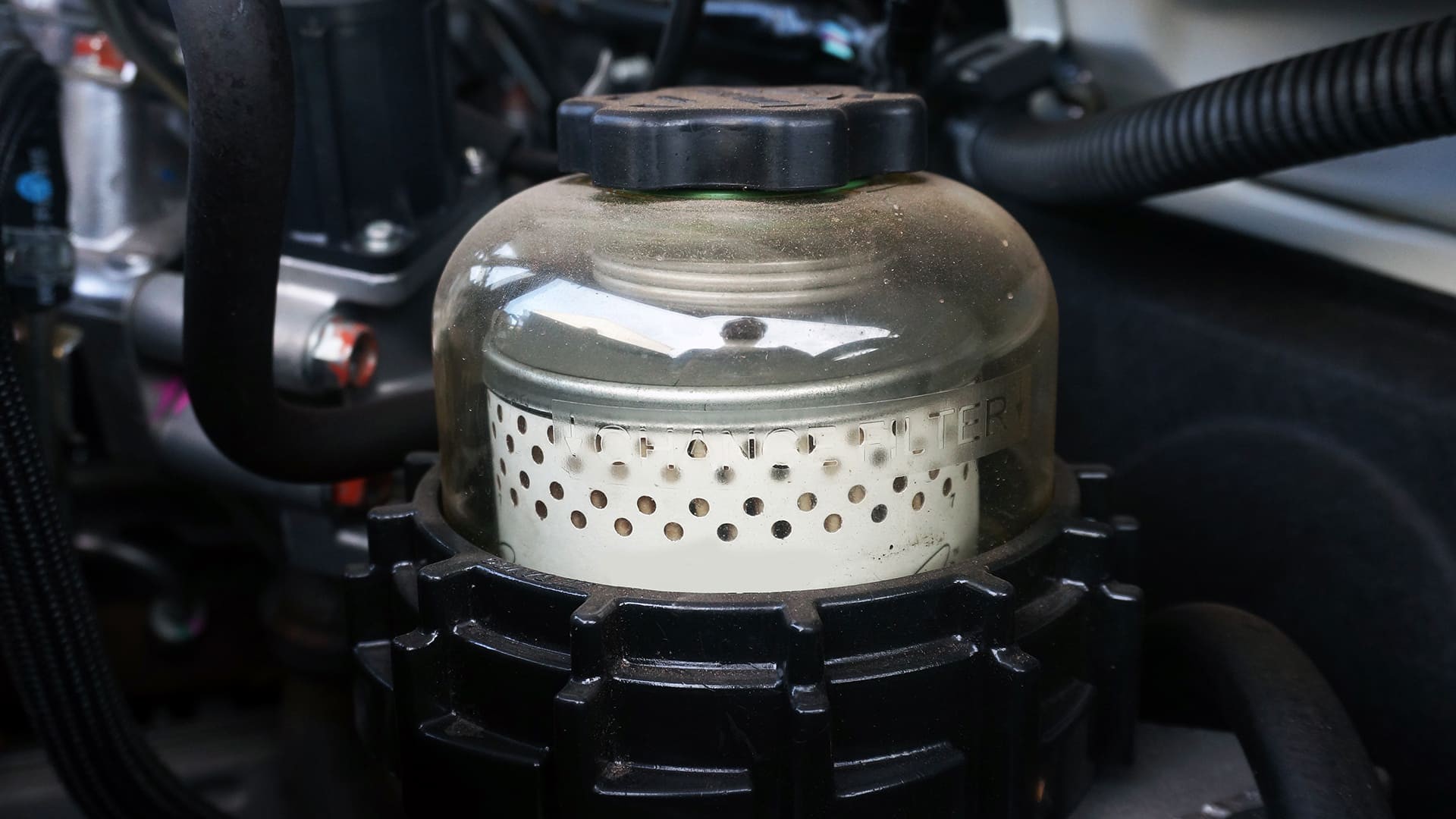
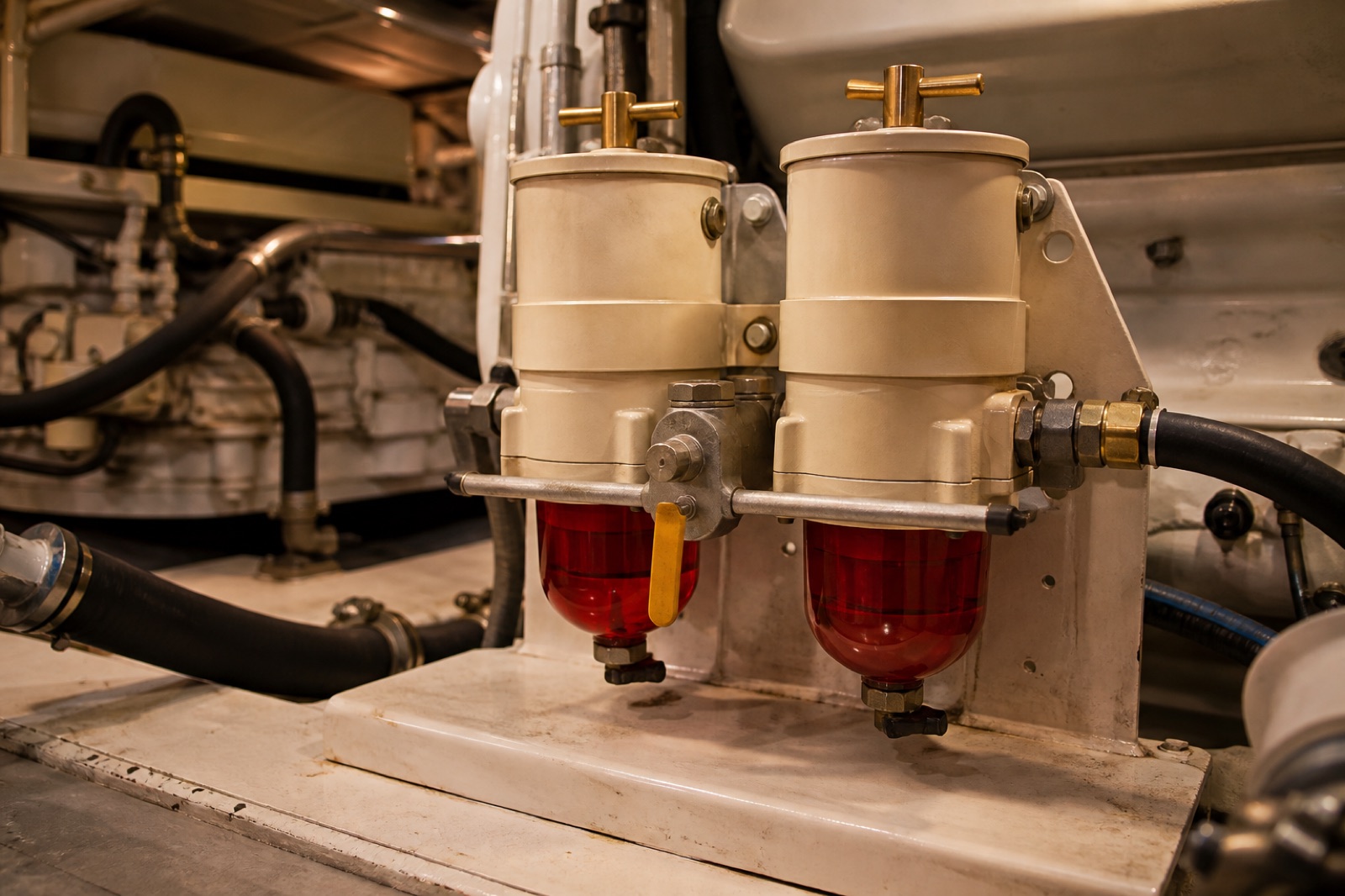
Fuel filtration on a standby or continuous-duty genset is a two-stage arrangement. The primary filter is a fuel-water separator, typically a Racor 1000-series (or Parker Turbine) on smaller frames and a Fleetguard FS1000-series on Cummins platforms, that removes free water and coarse particulates, generally rated at 30 µm nominal with a 99% water-removal efficiency to ISO 16332. The secondary filter is a fine engine-mounted element (Fleetguard FF5320 or FF5488 on Cummins C-series, CAT 1R-0750 or 326-1644 on 3500-series, Perkins CH11217 or similar) rated to 2–5 µm nominal with a β200 or better rating at 4 µm to ISO 19438.
Water is the single biggest fuel filtration issue in UAE gensets, and it comes from three sources: condensation in day tanks during the summer diurnal temperature swing (a partly-full tank cycling from 25°C at 06:00 to 45°C at 15:00 can precipitate 100–200 ml of water per cubic metre of ullage per day), poor bulk storage at the diesel supplier, and marine fuel contamination on any genset that shares a tank with a bunker line. The primary fuel-water separator is what keeps that water out of the injectors, and the fuel-water separator guide for diesel generators walks through the sizing math.
Cetane, sulfur and biodiesel content are the other three fuel-side variables. UAE.S GSO 42 caps diesel sulfur at 10 ppm since 2014, so acid-rain injector damage is rare on new fuel. Biodiesel blending is not standard on UAE diesel supply, so the microbial-growth risk that plagues B7 European diesel is smaller, but any genset drawing from a shared farm-diesel bulk tank in Al Ain agricultural areas should assume higher biological risk and shorten primary intervals accordingly. The fuel filter selection for UAE generators piece walks through the primary selection logic and the diesel generator filter maintenance in UAE summer piece covers the seasonal interval adjustments. We hold the full Racor line, Cummins Fleetguard fuel elements and the Caterpillar fuel filter range at the Aweer warehouse.
"Water in fuel is not a maintenance problem, it's a control-system problem," says Ravi Menon, marine and industrial diesel technical consultant, Dubai Maritime City. "If your day tank isn't polished and your primary separator isn't sized for the peak flow, you will inject water. The fuel-water sensor is your last defence, not your first line."
Air filtration: pre-cleaners, restriction gauges and sandstorm response
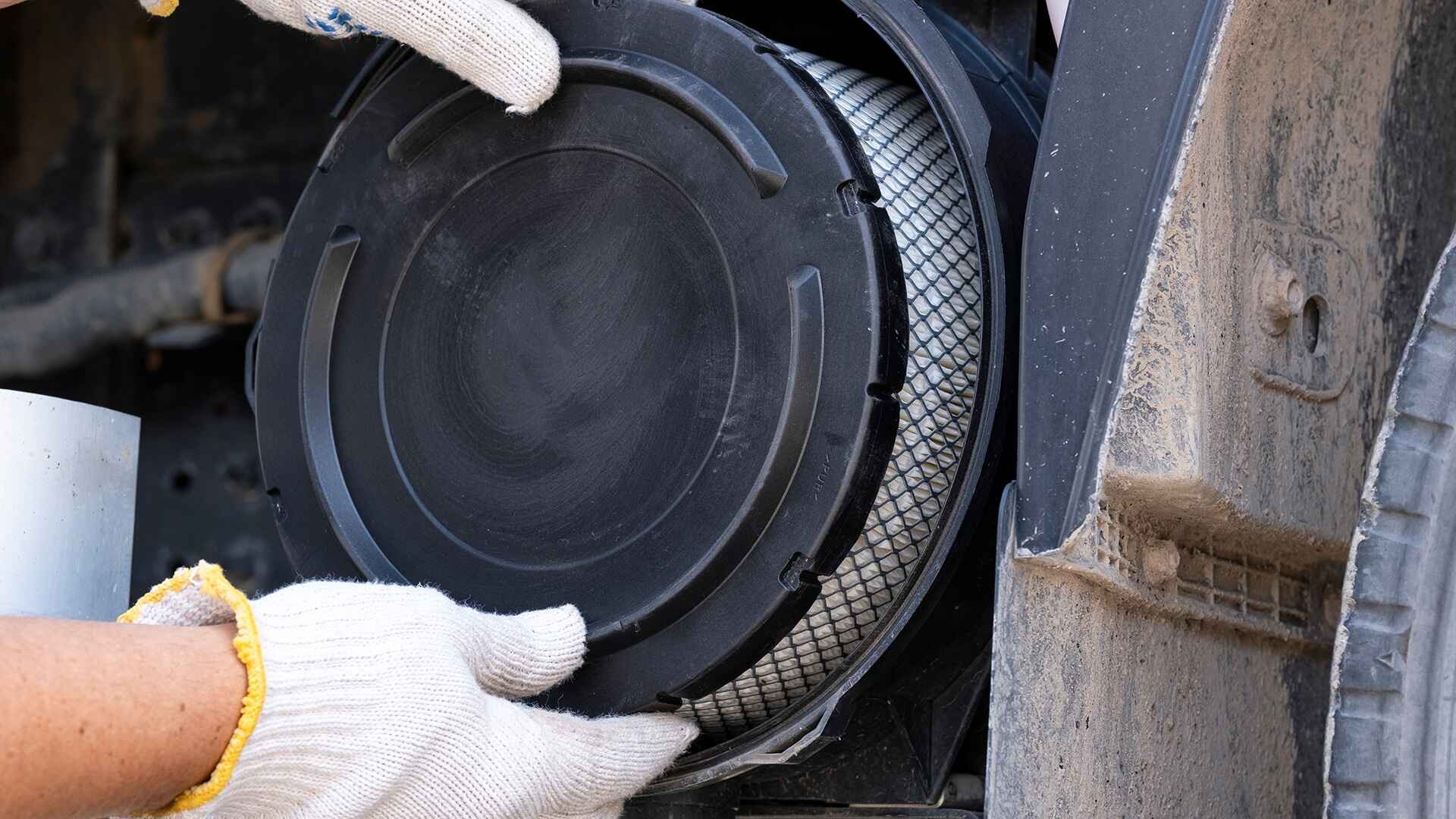
Genset air intake on any UAE site is a two-stage minimum: a primary air filter (typically Donaldson PowerCore or radial-seal on Cummins, CAT and Perkins offerings) plus a secondary safety element that catches ingested dust in the event of a primary failure or seal breach. Larger installations add a pre-cleaner: a cyclonic or vane-type device that centrifugally drops out coarse particulate before it reaches the primary element, extending primary life by 3–5x in high-dust conditions (Donaldson Technical Bulletin TB-2016-01).
Restriction is the trigger. OEM terminal restriction figures, typically 25 in H₂O naturally aspirated, 30 in H₂O turbocharged, are what tells the operator the primary is done. A restriction gauge with a resettable telltale is standard on all major genset platforms and should be checked on every scheduled walk-around; on continuous-duty sites during shamal season, that becomes a daily check.
Sandstorm response is where UAE genset operators need a written procedure, not a rule of thumb. During a moderate shamal (24-hour PM10 running average 200–400 µg/m³, sustained wind above 25 knots from the north-west), a naturally-aspirated Perkins 4008 on a Sajaa site can move from 15 in H₂O to full 30 in H₂O restriction in 24 hours. The sandstorm heavy equipment air filter protection piece has field data, and the air filter replacement for dusty environments in Dubai piece covers the operational adjustments.
Ratings-wise, genset air filters are typically 99.9% capture at 3 µm to ISO 5011 : the industry benchmark for engine intake filtration. Donaldson's high-efficiency Ultra-Web nanofibre media pushes that to 99.99% at 3 µm at a modest DP penalty, and is the preferred spec on data-centre gensets in Khalifa Port and Sajaa where turbocharger reliability is non-negotiable. The Donaldson product line is our primary stock for those applications, and the nanotechnology filters overview covers the newer media families.
Oil filtration and lube analysis
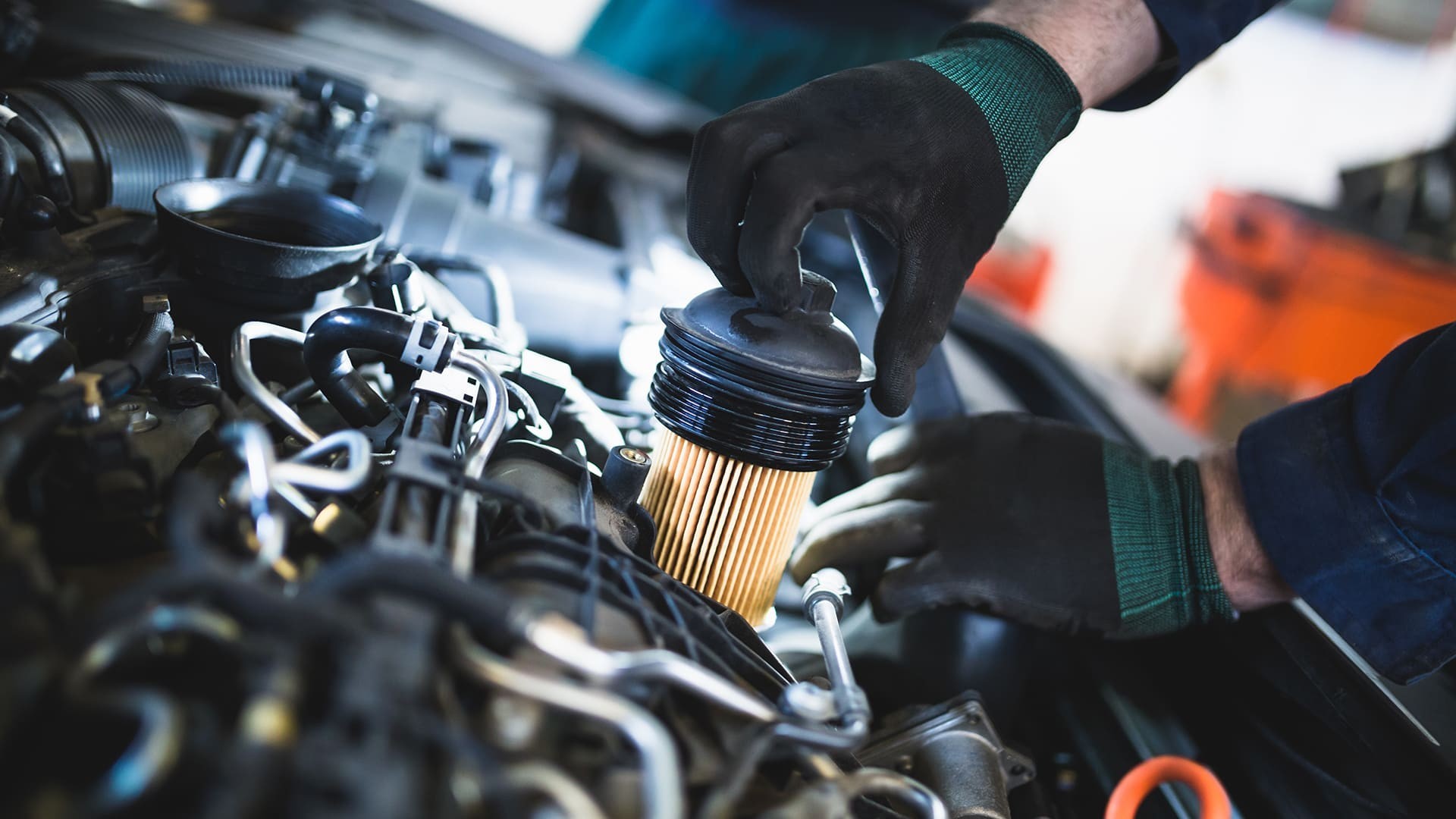
Genset lube filtration is a full-flow spin-on or cartridge element (Fleetguard LF9080 on Cummins ISX and QSX, LF14000NN on ISM/QSM, CAT 1R-1808 on 3500-series, Perkins CV31201 on 4000-series) plus, on larger platforms, a bypass filter that filters roughly 10% of oil flow through a much finer media (2–3 µm at β200) on a slower duty cycle. The full-flow protects the bearings from immediate damage; the bypass drives the oil towards a cleaner steady-state condition over time.
The condition-based trigger on the lube side is oil analysis. Sampling every 250 operating hours on continuous-duty gensets and every 500 hours (or half the OEM interval, whichever is sooner) on standby gensets catches the two failures that matter: soot loading above 1.5% (indicating combustion or intake trouble) and iron trending (indicating bearing or liner wear before it becomes catastrophic). The fleet filter maintenance checklist covers the sampling protocol.
Oil selection matters as much as filter selection. A CI-4 or CJ-4 rated 15W-40 (industry-standard for most heavy-duty genset applications) will hold different soot loadings than a CK-4; a CK-4 will run cleaner through the LF9080 for the same duty. That interaction is why oil supplier and filter supplier conversations need to happen together, not sequentially. The synthetic vs cellulose filter media piece covers the media-oil interaction in detail.
"An LF9080 with CK-4 oil in a QSK19 will run to 400 hours easily on a standby genset," says Bilal Rahman, filtration technical trainer with a Cummins dealer network. "The same filter with a lower-spec CH-4 oil in the same machine we've seen close to bypass at 220 hours. Same machine, same duty, different oil. Filter didn't fail, the oil did."
Cummins platform specifics: QSK, QSX, C-series
Cummins is the largest single genset installed base in the UAE for standby power in commercial and healthcare, and its filtration lines are the deepest we stock. QSK19/23/38/50/60/78/95: the big prime-power and mission-critical frames, run LF9080 (or LF14000NN on larger displacement variants) for lube, FS1000 or FS1022 primary fuel-water separator, FF5320 secondary fuel, and AF25812 or AF26389 air on radial-seal Donaldson-badged housings. Service intervals under continuous-duty UAE conditions typically compress to 250 hours on the lube and fuel, and to restriction-triggered replacement on the air side.
QSX15 on generator-set duty (typical Middle East hospital 500–800 kW range) uses LF9080 lube, FF5488 secondary fuel and AF25588 air, with the same interval compression. The C-series (C1100D5, C1400D5, C1650D5), the workhorse standby range for hotels, data centres and telecom towers, carries a similar line-up with platform-specific size differences.
Cummins Service Bulletin SB-14-2019 explicitly recommends 250-hour intervals on lube and fuel for Middle East and India regions rather than the 500-hour figure in the standard operator's manual. That is the interval to build the CMMS schedule around, not the base manual. We stock the full Cummins Fleetguard line with cross-references documented for ISO 9001 audit trail; the where to buy Fleetguard filters in the UAE piece covers the direct-distribution model.
Caterpillar platform specifics: C-series, 3500-series
CAT gensets, CAT C9, C15, C18, C27, C32 on the smaller-to-mid range, and CAT 3512, 3516 on the prime-power and continuous-duty side, carry Cat-branded filters that are typically Donaldson-manufactured under private label. Common lube part numbers include 1R-0716 and 1R-1808; primary fuel-water 1R-0770 (Racor-based), secondary fuel 1R-0750 or 326-1644 (later Tier 4 emissions-compliant frames), and air 6I-2504 or 275-4370 depending on frame size.
The 3500-series is the mission-critical prime-power frame in a lot of UAE data centre and utility installations. Its lube filter service on continuous duty in UAE conditions runs 250 hours against a 500-hour base manual figure; the secondary fuel filter runs 250–300 hours; the air side is restriction-triggered. Caterpillar's SEBU8257 Middle East service supplement carries the region-specific interval adjustments. The Caterpillar vs Perkins filter comparison piece works through the cross-reference options where a customer wants aftermarket parts on CAT frames, and the full Caterpillar filter line is stocked at Aweer.
"CAT 3512 in Middle East duty is not a 500-hour lube interval, whatever the operator's manual says," says Yusuf Ibrahim, senior generator technician at an Abu Dhabi utility contractor. "250 hours or you're rebuilding turbos every three years. It's the environment, not the engine."
Perkins platform specifics: 1100, 2500, 4000-series
Perkins gensets, 1100-series for small/mid standby (1103, 1104, 1106), 2500-series (2506, 2806) for mid-power, and 4000-series (4006, 4008, 4012, 4016) for prime-power, carry Perkins-branded filters typically sourced from a mix of Fleetguard and Donaldson under private label.
Common lube part numbers are 2654407 or CV31201; primary fuel-water 26560201 or Racor equivalents on 4000-series; air filters typically Donaldson PowerCore or radial-seal in the 4000 range. Perkins operator's manuals list a 500-hour interval on most standby gensets; in UAE continuous-duty applications, the compressed 250-hour interval applies here too.
The 4008 and 4012 are particularly common in UAE data centre and telecom-tower applications. Their air filtration is a two-stage arrangement with pre-cleaner on almost every installed unit, and dust-blinding during shamal season is the failure mode that dominates unplanned outages. Perkins Technical Information Bulletin TIB 2020-14 covers the Middle East service-supplement intervals. We keep the aftermarket cross-references for the Perkins service range documented at Aweer with certificate of conformity on every dispatch. The diesel generator filter maintenance in the UAE piece and the choose fuel filter for generator UAE piece cover the field application on Perkins platforms.
FAQ
Where do you stock genset filtration in the UAE? On the power generation filtration industry page. This guide is the sequence and the intervals. That page is the Aweer inventory for Cummins, CAT, and Perkins kits.
How often should I change fuel filters on a UAE-based diesel generator? Every 250 operating hours on continuous or prime-power duty, and every 500 hours (or half the OEM interval, whichever is sooner) on standby duty. Change immediately on any fuel-water sensor trip regardless of hours, and immediately after any known fuel-supply event (bad delivery, tank contamination, day-tank water accumulation). Cummins SB-14-2019 explicitly recommends 250-hour intervals for Middle East service.
Do UAE summer temperatures affect filter life? Yes, significantly. Oil oxidation rate roughly doubles for every 10°C rise in sump temperature, so a sump running 65°C oxidises oil at close to four times the rate of a 45°C sump. Filter media life on the lube side compresses proportionally. Air filter life falls with intake air density (12% lower at 45°C than at 25°C) meaning higher flow demand for the same power output, higher DP and shorter interval.
What's the difference between primary and secondary fuel filtration? Primary is a fuel-water separator, typically 30 µm nominal with 99% water removal to ISO 16332 : the Racor 1000-series or Fleetguard FS1000 is the typical example. Secondary is a fine engine-mounted element, 2–5 µm nominal with β200 or better at 4 µm to ISO 19438 : Fleetguard FF5320 or CAT 1R-0750 is typical. Primary removes water and coarse particulate; secondary protects the injectors from fine particulate.
Why do genset air filters plug faster during shamal season? UAE shamal storms (March–May) drive 24-hour PM10 running averages above 300 µg/m³ and single-event peaks above 900 µg/m³. That is 15–60x the WHO annual guideline. Air filter dust loading is directly proportional to intake PM concentration and total flow, so a shamal-day generator running on load can compress a normal 500-hour air filter interval to 100–200 hours. Daily restriction gauge checks and pre-cleaners are the operational response.
Can I use aftermarket filters on a Cummins genset without voiding warranty? Yes, provided the aftermarket filter meets the OEM specification at the same test method (ISO 16889 for lube and hydraulic, ISO 19438 for fuel, ISO 5011 for air) with documented beta ratio and micron rating. The Magnuson-Moss Act and equivalent UAE consumer protection principles prevent an OEM from voiding warranty solely because an aftermarket filter was used, provided that filter is not the cause of the failure. Documentation on the OEM vs aftermarket filters piece covers the audit trail.
What is the correct oil analysis sampling cadence? Every 250 operating hours on continuous-duty and prime-power gensets, and every 500 hours (or half the OEM interval) on standby duty. Sample from a live line through a properly-flushed port, and trend the numbers rather than reading absolute values. Iron trending, soot loading above 1.5%, and viscosity moving out of grade are the three flags that drive interval adjustment.
Are Cummins Fleetguard, CAT and Perkins filters interchangeable? No, housing dimensions, thread pitches, bypass valve settings and gasket profiles vary by platform. Cross-references exist between OEM and aftermarket for each platform (Fleetguard, Baldwin, Donaldson, MANN, Wix), but a Cummins Fleetguard filter is not a drop-in for a CAT engine and vice versa. The correct approach is documented cross-reference on the specific platform, matching beta ratio and micron rating at the same test standard.
How do I document filter substitutions for ISO 9001 audit? Record OEM part number, aftermarket substitute part number, governing test standard (ISO 16889, ISO 19438, ISO 5011), replacement trigger (hours, DP, oil analysis result), technician, and disposal manifest. Every filter dispatched from our Aweer warehouse across the UAE authorized network includes cross-reference documentation and certificate of conformity precisely for this audit-trail requirement.
What's the risk of running "cheap" aftermarket filters on gensets? The dominant failure mode is lower beta ratio at the nominal micron, a β75-at-20µm filter passes about four times the particles a β200-at-20µm filter passes. That difference doesn't show at installation; it shows on the turbocharger inspection three years later and on the oil analysis trend six months earlier. The true cost of cheap filters piece runs the actual numbers.
Where can I get emergency genset filters in the UAE outside working hours? Our authorized inventory runs 24-hour availability for critical dispatches through the Aweer warehouse and the wider UAE distribution network. The emergency filter sourcing across the 24-hour GCC piece explains the operational model for after-hours stockouts on critical genset lines.
Authoritative outbound references
- Cummins Fleetguard technical service bulletins
- Caterpillar SEBU8257 Middle East service supplement
- Perkins Engines technical information bulletins
- Donaldson Ultra-Web technology overview
- Racor fuel filtration product library
- ISO 5011 inlet air cleaning equipment for internal combustion engines and compressors
- ISO 19438 diesel fuel filter efficiency test




 Facebook
 Instagram
 LinkedIn