By Meera Ajesh, Chief Operating Officer, ThinkFilter, Aweer warehouse, Dubai. Last updated 4 August 2026.
If you've ever stared at a filter spec sheet and wondered why one part is rated to "20/18/15" and another to "MERV 14," you already know the problem. UAE facilities pull filters from four different rulebooks, hydraulic cleanliness codes, marine fuel specs, HVAC efficiency ratings, and outdoor air PM classes, and none of those rulebooks talk to each other in plain language. This guide fixes that. We stock filters against all four, and every part in our Aweer warehouse gets cross-referenced from the OEM catalog before it ships. What follows is the working knowledge our procurement clients ask for most often, laid out the way a UAE fleet or plant engineer actually needs it.
Table of Contents
- Why UAE filtration standards need their own guide
- ISO 4406: hydraulic and lubricant cleanliness codes
- ISO 8217: marine fuel oil specifications
- ASHRAE 52.2: MERV ratings for HVAC filters
- ISO 16890: the outdoor-air PM classification
- Local UAE regulatory context: ESMA, MOCCAE, Dubai Municipality
- Cross-reference workflow: from OEM part to compliant substitute
- FAQ
Why UAE filtration standards need their own guide
The UAE runs harder on filters than most markets. Ambient temperatures cross 48°C in July and August (National Center of Meteorology, Abu Dhabi, 2025 annual summary), airborne PM10 in Dubai has averaged around 132 µg/m³ over the last decade, well above the WHO 15 µg/m³ annual guideline (WHO Global Air Quality Guidelines, 2021), and Fujairah bunker traffic hit roughly 8 million tonnes in 2024, making it the world's second-largest bunkering port after Singapore (Fujairah Oil Industry Zone data, 2024). Standard European filter change intervals collapse under those loads. Sandstorm intake damage in the March–May shamal season alone can dust-load a Donaldson PowerCore air unit inside 40 operating hours on a Cat 966 loader (Donaldson Technical Bulletin TB-2016-01, "Extreme Dust Applications").
That environmental profile is why every category we stock, industrial filters, oil filters, air filters, fuel filters, hydraulic filters, needs to be evaluated against the applicable ISO or ASHRAE code, not just the OEM part number. A filter that meets the OEM spec in Rotterdam will not necessarily hold that spec in Aweer at 46°C ambient with 60% relative humidity.
"The single biggest procurement error I see in the Gulf is buying to part number alone," says Vikram Shetty, senior filtration engineer at a Jebel Ali marine services group. "Two filters can share a cross-reference and still deliver very different beta ratios once you're pushing 45°C oil temperature. You have to buy to the standard, not just the number."
ISO 4406: hydraulic and lubricant cleanliness codes
ISO 4406:2021 is the language hydraulic systems speak. It expresses fluid cleanliness as a three-number code, for example, 20/18/15: where each number is a range code counting particles larger than 4 µm, 6 µm, and 14 µm per millilitre of fluid respectively. Move up one code number and you double the particle count. That's why a jump from 18/16/13 to 20/18/15 sounds small but represents roughly four times the contamination.
Most excavator, wheel loader, and injection-moulding manufacturers publish a target ISO 4406 code for their hydraulic circuit. Caterpillar's SEBU6250 lubricants and fluids manual, for example, targets 18/16/13 for pilot systems and 20/18/15 for main hydraulics on 300-series excavators. Bosch Rexroth's RE 07075 datasheet lists 17/15/12 as the cleanliness required for servo-proportional valves. Miss those codes by two range numbers and the industry data is unambiguous: Noria Corporation's oil analysis field studies published in Machinery Lubrication have repeatedly shown that pushing ISO 4406 cleanliness one code cleaner extends hydraulic component life by roughly 50% for pumps and 100% for servo valves (Noria, "Target Cleanliness Levels," 2019).
Reading the code on a shop floor is the easy part. Achieving it is where filter selection matters. That means matching the beta ratio (β) of your filter element to the particle you need to remove, and pairing that with adequate dirt-holding capacity for the duty cycle. A β1000 rating at 10 µm(c), meaning the filter captures 999 out of 1,000 particles at 10 microns, is the working baseline for a main-return element on a Cat 336 excavator working the Al Ain quarries. For deeper coverage of the math, see our companion piece on beta ratio and hydraulic filter efficiency and the practical replacement signals in signs a hydraulic filter needs replacing.
Cross-referencing an OEM hydraulic filter to a compliant aftermarket in the UAE means checking three data points, not one: nominal micron rating, beta ratio at that micron, and dirt-holding capacity in grams. We publish these on the Hydac and Parker product pages precisely so a workshop foreman doesn't have to phone Germany at 2 am.
ISO 8217: marine fuel oil specifications
ISO 8217:2024 is the international residual and distillate marine fuel spec. It classifies marine fuels into distillate grades (DMX, DMA, DMZ, DMB) and residual grades (RMA to RMK), setting hard limits on kinematic viscosity, sulfur content, density, water content, aluminium plus silicon (a proxy for catalytic fines from refinery FCC units), and total sediment.
Three numbers dominate every procurement conversation in Fujairah and Khor Fakkan. First, sulfur cap: since IMO 2020, global marine fuels are capped at 0.50% m/m sulfur and Emission Control Area (ECA) fuels at 0.10% m/m (IMO Resolution MEPC.305(73)). Second, catalytic fines: ISO 8217:2024 caps aluminium plus silicon at 60 mg/kg for RMG 380, but bunker samples reported by the Veritas Petroleum Services fuel quality bulletin for Q4 2023 flagged over 4% of Fujairah stems exceeding that limit at the receiving vessel manifold, after settling and separator work, which is why on-board filtration is not optional. Third, water: the ISO limit is 0.50% v/v for residual grades, and free water above that will strip lube from injection pump plungers inside 200 running hours (MAN Energy Solutions Service Letter SL2018-660).
"Catalytic fines are the silent killer in Gulf bunkering," says Erik Lindqvist, marine fuel consultant, Copenhagen. "You can meet ISO 8217 at the bunker barge and still deliver 40 mg/kg of cat fines to the engine if your separators and Racor filters are underspecified for the vessel's fuel consumption rate."
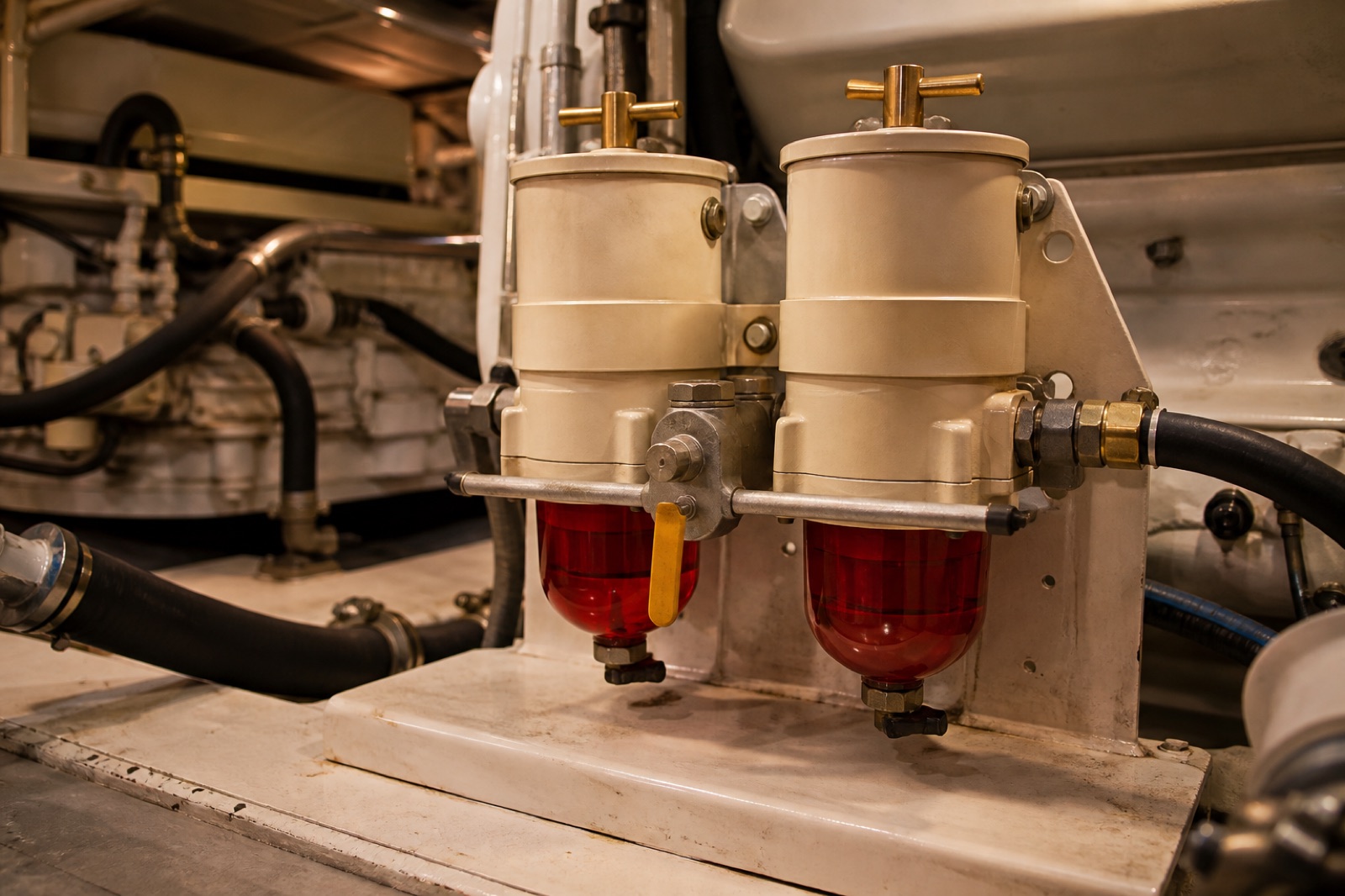
The practical answer on a UAE-flagged vessel or a Fujairah-anchored offshore support vessel is a two-stage arrangement: a fuel-water separator on the transfer line (Racor 1000-series or Parker Turbine on tugs and OSVs; larger frames on merchant tonnage) plus a fine secondary filter on the engine inlet rated to remove particles down to 5 µm(c) at β200. That sequence is what our marine fuel filtration best practices piece walks through in operational detail, and the fuel-water separator guide for diesel generators covers the same principles for shore-based gensets. We stock the full Racor family for both applications.
ASHRAE 52.2: MERV ratings for HVAC filters
ASHRAE Standard 52.2-2017 is the North American HVAC filter efficiency test. It reports a Minimum Efficiency Reporting Value (MERV) from 1 to 16, based on a filter's minimum composite efficiency across three particle-size ranges (E1 = 0.3–1.0 µm, E2 = 1.0–3.0 µm, E3 = 3.0–10.0 µm). Higher MERV means more capture; a MERV 8 filter typically captures 70–85% of 3–10 µm particles, while a MERV 14 captures ≥90% of 1–3 µm particles and ≥75% of 0.3–1 µm particles (ASHRAE 52.2 Appendix J).
For commercial buildings across Dubai, Sharjah and Abu Dhabi, the MERV number picked at design stage lives with the building for its whole life. Dubai Municipality's Green Building Regulations (2020 edition, section 501.03) require a minimum of MERV 8 pre-filter plus MERV 13 final filter on outdoor-air handling units serving occupied spaces. Abu Dhabi's Estidama Pearl Rating System pushes similar thresholds in its Pearl 2 and Pearl 3 tiers. Selecting under those thresholds, or letting a facilities team drop back to MERV 7 to save on differential pressure, trips the annual retro-commissioning audit and can void LEED points already banked.
"MERV 13 in Dubai isn't a nice-to-have, it's baseline," says Priya Menon, senior mechanical engineer at a Dubai Design District consultancy. "The outdoor PM2.5 loading we deal with, combined with 12-month operating hours, means anything less than MERV 13 becomes a re-filter on a 4-month cycle and your energy bill takes the hit through pressure drop."
We stock MANN commercial HVAC and Camfil-equivalent MERV 8 through MERV 16 stock at Aweer for same-day dispatch across the UAE. The companion read on the specification-selection side is HVAC air filtration for commercial buildings in the UAE, and for procurement teams comparing media types the synthetic vs cellulose filter media piece covers the trade-offs.
ISO 16890: the outdoor-air PM classification
ISO 16890:2016 is the European replacement for the old EN 779 F-class system, and it reports HVAC filter efficiency in the language building health regulators actually care about, particulate matter mass fractions. A filter is rated as ISO ePM1, ePM2.5, ePM10, or ISO Coarse, and it is assigned a percentage efficiency against that PM size. An ISO ePM1 70% filter, for example, removes at least 70% of PM1 particles (the sub-micron fraction most linked to cardiovascular disease and long-term mortality in WHO's 2021 Global Air Quality Guidelines).
ISO 16890 is now the reference standard for UNI-EN, JIS, and Middle East HVAC procurement RFPs written after 2020, and it maps more cleanly than MERV onto WHO air-quality guidance. As a rough (not one-to-one) cross-walk: MERV 11 ≈ ISO ePM10 60% or ISO ePM2.5 50%; MERV 13 ≈ ISO ePM2.5 65% or ISO ePM1 50%; MERV 14 ≈ ISO ePM1 60–70%; MERV 16 ≈ ISO ePM1 ≥85%. The full mapping is published in Eurovent 4/23 "Selection of EN ISO 16890 Rated Air Filter Classes."
For UAE facilities managers, the operational upside of ISO 16890 is that it makes health-based procurement defensible. If a hospital tender in Abu Dhabi requires 80% PM2.5 capture at design conditions, an ISO ePM2.5 80% part meets that requirement on paper and in the differential-pressure logs. MERV alone cannot make that claim because it doesn't test at PM mass fractions directly. Our dusty-environment air filter replacement piece walks through how this changes the change-out schedule in Al Quoz workshops, and the nanotechnology filters overview covers newer media families being specified into UAE data centres.
Local UAE regulatory context: ESMA, MOCCAE, Dubai Municipality
Federal and emirate-level rules layer on top of the ISO and ASHRAE codes. The Ministry of Industry and Advanced Technology (MoIAT): which absorbed the former ESMA (Emirates Authority for Standardization and Metrology) in 2020, publishes UAE.S GSO standards through the GCC Standardization Organization framework. UAE.S GSO ISO 8217 is the direct national adoption of the marine fuel spec. UAE.S GSO ISO 4406 similarly adopts the hydraulic cleanliness code. These are the standards a Dubai Customs product-conformity assessment will check against on imported filter elements.
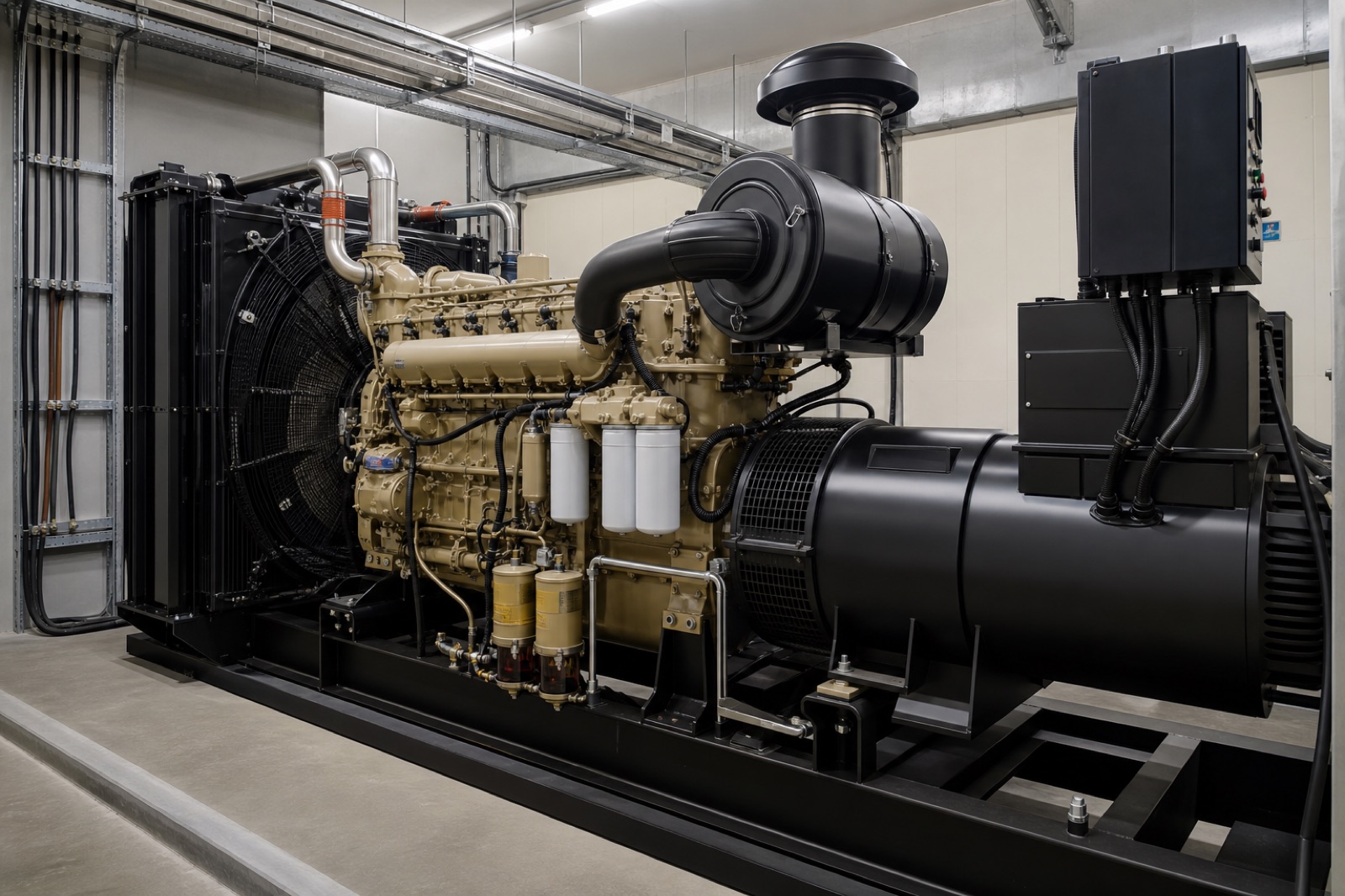
The Ministry of Climate Change and Environment (MOCCAE) enforces Federal Law No. 24 of 1999 on protection of the environment, updated by Federal Decree-Law No. 11 of 2024. Emissions from stationary sources, including diesel gensets serving telecom towers, hospitals and data centres, are regulated under Cabinet Resolution No. 12 of 2006 on Ambient Air Quality Protection. Practically, that means the intake and crankcase filtration on a Cummins C1100D5 backing up a Dubai hospital has to keep particulate emissions below the point limits published in Annex 5 of that resolution.
Dubai Municipality's Public Health and Safety Department runs the indoor-air-quality programme; hotels, shopping malls and schools inspected under it must show HVAC filter maintenance records and MERV/ISO 16890 compliance certificates during audit. Abu Dhabi's Environment, Health and Safety Center (EHS Center) operates the same regime under EHSMS RF (Environment, Health and Safety Management System Regulatory Framework), Version 3.1.
The cross-referencing implication is that a compliant aftermarket filter used in a UAE facility needs, at minimum, evidence of conformity to the applicable ISO/ASHRAE standard plus a UAE.S GSO product declaration or equivalent OEM technical data sheet on file. That paperwork is what we hand across with every order out of Aweer, and it's what avoids a nasty conversation during a Dubai Municipality inspection. The OEM vs aftermarket piece expands on how procurement teams document that trail.
Cross-reference workflow: from OEM part to compliant substitute
The workflow we use every day at the Aweer counter comes down to five steps. Start with the OEM part number as printed on the housing or in the equipment service manual, say Cummins Fleetguard LF9080 on a QSK19 genset. Look up the OEM technical specification: media type, nominal micron rating, beta ratio at nominal micron, dirt-holding capacity, bypass valve pressure, and gasket dimensions. For the LF9080 that means Stratapore synthetic media, β25≥200 (99.5% at 25 µm), around 210 g dirt-holding capacity, and a 172 kPa bypass. That spec sheet is the reference point every substitute has to meet or exceed.
Third, identify the governing standard: ISO 4406 target for the machine's hydraulic or lube circuit, ISO 8217 grade for the fuel, ASHRAE 52.2 MERV or ISO 16890 class for the airside. Fourth, shortlist candidate cross-references from at least two aftermarket sources, Baldwin, Donaldson, MANN, and pull their datasheets. Compare beta ratios at the same micron, same test standard (ISO 16889 for hydraulic and lube, ISO 19438 for fuel, ASHRAE 52.2 for HVAC). If one supplier quotes β200 at 25 µm and another quotes β75 at 20 µm, they are not equivalent, the second is coarser. Fifth, document the substitution with the OEM part number, the aftermarket part number, the governing standard, and the test method. That's the audit trail regulators and warranty auditors ask for.
We publish tools that speed each of those steps. The top filter brands available in Dubai piece is the launching pad for brand shortlists; Fleetguard vs Donaldson for UAE fleets and the Caterpillar vs Perkins comparison work through side-by-side spec matches; the hydraulic filter cross-reference guide covers the hydraulic-specific version of this workflow. For urgent stock-outs, emergency filter sourcing across the 24-hour GCC shows how our authorized inventory model works in practice, and where to buy Fleetguard filters in the UAE explains the direct-distribution route for the largest single-brand deployment.
"A cross-reference isn't valid until the beta ratio and micron rating line up at the same test standard," says Ahmed Fahim, filtration technical consultant with a Mussafah heavy-equipment workshop group. "Nine times out of ten, when a client tells me an aftermarket filter failed early, the beta ratio was quoted at a different micron than the OEM. Same number on the housing, different filter."
That's the pattern this whole guide points to: the OEM part number gets a customer into the ballpark; the ISO or ASHRAE standard is what actually keeps their equipment inside its cleanliness target and their auditor off their back. If you want to walk through a specific cross-reference with our technical desk, our team at the Aweer warehouse is the fastest route in the country.
FAQ
What is ISO 4406 and how do I read the code? ISO 4406:2021 reports hydraulic fluid cleanliness as three range codes for particles ≥4 µm, ≥6 µm, and ≥14 µm per millilitre of fluid. A code of 20/18/15 means roughly 5,000–10,000 particles ≥4 µm, 1,300–2,500 particles ≥6 µm, and 160–320 particles ≥14 µm per ml. Each code number represents a doubling of particle count, so a 22/20/17 fluid is roughly four times dirtier than 20/18/15.
What does ISO 8217 cover for marine fuel in the UAE? ISO 8217:2024 is the international marine fuel specification adopted by the UAE via UAE.S GSO ISO 8217. It defines distillate grades (DMX, DMA, DMZ, DMB) and residual grades (RMA through RMK), with hard limits on viscosity, density, sulfur (0.50% m/m global, 0.10% ECA), water (0.50% v/v residual), and aluminium plus silicon catalytic fines (60 mg/kg for RMG 380).
How does MERV differ from ISO 16890? MERV (ASHRAE 52.2) rates HVAC filters 1–16 based on minimum efficiency across three broad size ranges from 0.3 to 10 µm. ISO 16890 rates them against particulate matter mass fractions, PM1, PM2.5, PM10, matching how WHO and health regulators express air quality. MERV 13 ≈ ISO ePM1 50% or ePM2.5 65%. ISO 16890 is preferred where PM-based procurement specs apply.
Is MERV 13 mandatory in Dubai buildings? Dubai Municipality's Green Building Regulations (2020, section 501.03) require MERV 8 pre-filters plus MERV 13 final filters on outdoor-air handling units serving occupied spaces. Estidama in Abu Dhabi sets comparable thresholds for Pearl 2 and Pearl 3 buildings. Dropping below MERV 13 without an approved variance risks failing the annual retro-commissioning audit and forfeiting sustainability rating points.
What ISO 4406 code should my Caterpillar excavator hydraulic system hit? Caterpillar SEBU6250 targets 18/16/13 for pilot systems and 20/18/15 for main hydraulics on 300-series and 350-series excavators. Servo-controlled and proportional-valve circuits, including many Bosch Rexroth systems on injection moulding, target 17/15/12. Actual figures should always be confirmed against the specific machine's operation and maintenance manual, since some later platforms have tighter targets.
Do UAE regulators enforce ISO filter standards directly? Yes, indirectly. UAE.S GSO adoptions of ISO 8217, ISO 4406, and ISO 16890 are the national reference standards; Dubai Customs product-conformity assessments and MOCCAE emissions inspections check against them. Dubai Municipality and Abu Dhabi's EHS Center audit HVAC compliance against the applicable MERV or ISO 16890 class documented in the building's design submission.
What paperwork should a compliant aftermarket filter come with? At minimum, a technical data sheet showing conformity to the applicable ISO or ASHRAE test method (ISO 16889 for hydraulic and lube, ISO 19438 for fuel, ASHRAE 52.2 or ISO 16890 for air) plus a UAE.S GSO product declaration or OEM certificate of conformity. That documentation is what regulators, warranty auditors and ISO 9001 internal audits look for during a filter substitution review.
How often should I re-check my cross-reference list? At least annually, and any time an OEM issues a new service letter or technical bulletin on the parent filter. OEMs revise media specifications more often than most operators realise, a Fleetguard LF9080 in 2018 is not identical to a 2024 unit, even at the same part number. We refresh our internal cross-reference tables quarterly against the current OEM catalog.
Where do I find authorized stock in the UAE? Our authorized inventory across the UAE network, Dubai (Aweer, Al Quoz), Abu Dhabi, Sharjah, Jebel Ali, Sajaa, Al Ain, and Mussafah, is stocked same-day for the OEM and aftermarket lines referenced throughout this guide.
What is a beta ratio and why does it matter for standards compliance? Beta ratio (β) is the ratio of upstream to downstream particles at a given micron size under ISO 16889 multipass testing. A β1000 rating at 10 µm(c) means 999 out of 1,000 particles at 10 microns are captured, a 99.9% efficiency. Beta ratio is how filter standards translate into real ISO 4406 cleanliness performance, which is why matching the beta at the same micron is the make-or-break check in any cross-reference.
Authoritative outbound references
- ISO 4406:2021 hydraulic fluid power, fluids, method for coding the level of contamination by solid particles
- ISO 8217:2024 petroleum products, fuels (class F), specifications of marine fuels
- ANSI/ASHRAE Standard 52.2-2017 Method of Testing General Ventilation Air-Cleaning Devices
- ISO 16890 series, air filters for general ventilation
- IMO 2020 sulphur cap resolution MEPC.305(73)
- Donaldson Technical Bulletin library
- Cummins Fleetguard filtration technical library




 Facebook
 Instagram
 LinkedIn